By Dessalines Ferdinand, Editor-in-Chief _______________________
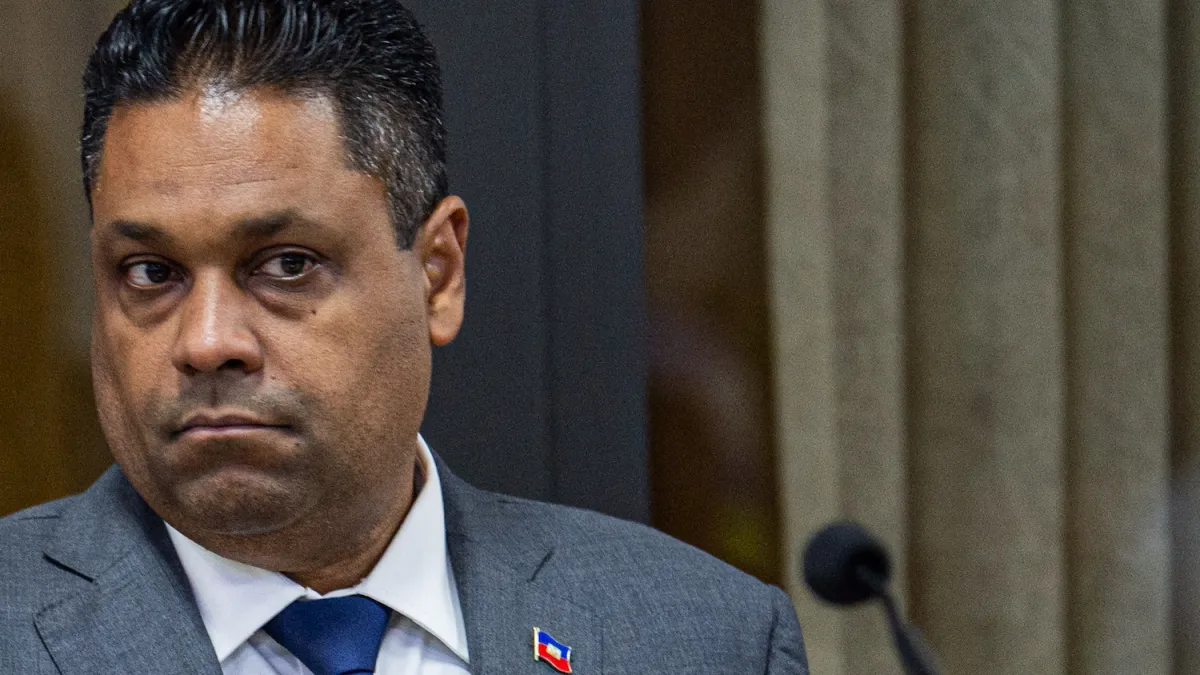
One had to pay close attention to learn that Laurent Saint-Cyr, the current President of Haiti’s Transitional Presidential Council (CPT) and an entrepreneur from the country’s economic elite—who arrived in Miami on Sunday, en route to Japan with a delegation of 20 people—is scheduled to meet on Monday, October 6, 2025, with a select group of leaders from across the Haitian community in South Florida, including representatives of the Haitian American Chamber of Commerce of Florida (HACCOF).
“We’re consulted, but never included,” confided one community leader who requested anonymity.
A trip without real stakes
At first glance, Saint-Cyr’s visit could be seen as an attempt to re-open dialogue between Port-au-Prince and the Haitian diaspora. A closer look, however, suggests a largely performative exercise, occurring as the CPT’s fate appears already determined by the U.S. State Department in Washington.
All indications suggest that the current transitional government will come to an end on February 7, 2026, a date now widely seen as the political deadline set by the international community.
What, then, can a private meeting in a church hall, far from public scrutiny and without a concrete working agenda, realistically achieve? This initiative seems motivated less by a desire to build a meaningful roadmap with the diaspora than by the urge to preserve appearances. Some observers even see it as a disguised farewell tour, especially as talks circulate regarding the formation of a new provisional team, reminiscent of the government led by the late Gérard Latortue in 2004, following the second ouster of President Jean-Bertrand Aristide.
A diaspora reduced to a supporting role
For years, the Haitian diaspora in South Florida has sought to assert its political relevance, yet it remains fragmented, divided, and devoid of structured leadership.
Self-appointed representatives, often linked to business or political circles, have failed to transform their financial or media influence into collective power. Their inability to speak with one voice, build sustainable coalitions, or propose a coherent agenda has rendered all dialogue with Haitian authorities effectively meaningless.
Certain groups, notably within HACCOF and the Macaya Group, often described as the economic arm of Haiti’s elite, limit their actions to ceremonies, photo opportunities, and predictable speeches. The case of the National Haitian American Elected Officials Network (NHAEON) further illustrates this ambiguity: though nominally nonpartisan, its neutrality is often undermined by the overt political positioning of some of its leaders.
It is also likely that Marleine Bastien, commissioner for Miami-Dade County’s District 2 and a respected social activist, will not attend. Known for her outspoken criticism of certain CPT members accused of corruption, Bastien is reported to have longstanding tensions with U.S. Representative Sheila Cherfilus-McCormick (FL-20), a lawmaker close to NHAEON’s leadership. Their strained relationship dates back to the 2020 legislative elections, when Bastien publicly endorsed Cherfilus-McCormick’s rival, Dale Holness. Holness, of Jamaican descent, has long been described by Bastien as a steadfast ally of South Florida’s Haitian community.
An initiative serving a narrow circle
Saint-Cyr’s visit once again exposes a troubling truth: the Haitian diaspora lacks legitimate interlocutors and genuine structures of influence.
Questions abound: Who authorized these individuals to speak on behalf of an entire community? Why hold a closed-door meeting, with no local press invited?
Such questions betray a deep discomfort: this initiative appears designed less to serve the collective interests of the diaspora than to benefit a small circle seeking proximity to political power.
The symbol of a system running on fumes
This closed-door session at Notre-Dame d’Haïti is more than a routine stop—it embodies the growing disconnect between Haiti’s political class and its diaspora.
At a time when the nation continues to sink into crisis, the moment demands transparency, accountability, and collective leadership. Yet none of these principles are evident in this meeting, which lacks a public report, an open consultation, or any concrete commitments.
A troubling precedent: the Garry Conille case
Recent history offers a telling precedent. On June 29, 2024, former Prime Minister Garry Conille also held a closed-door meeting in the same church, only to be forced out of office weeks later.
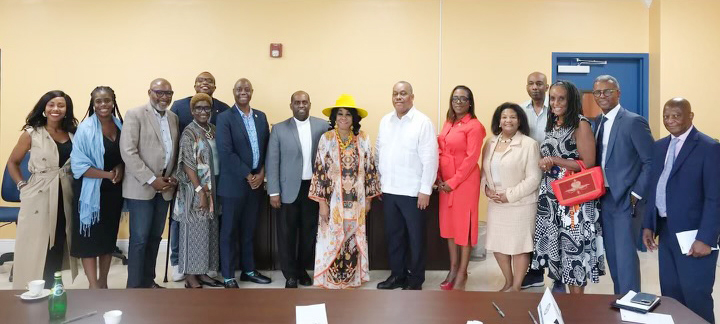
Is this a sign of things to come? Perhaps not. But the episode underscores the sterile and often counterproductive nature of these confidential meetings in symbolic diaspora spaces.
A political waste of time
Ultimately, this meeting is unlikely to yield any solution to Haiti’s crisis or any meaningful rapprochement between the diaspora and Port-au-Prince.
Rather, it highlights the fatigue of a political class desperate for legitimacy and the leadership vacuum of a diaspora elite absorbed in its own interests.
To put it bluntly: a closed-door meeting between Laurent Saint-Cyr and a handful of handpicked figures, from HACCOF, NHAEON, or the Macaya Group, does not address the urgency of the moment.
With the CPT’s mandate apparently set to expire on February 7, 2026, Haiti no longer needs symbols, it needs proof of governance and action.
The recent warning by U.S. Chargé d’Affaires Henry Wooster, delivered on September 24, 2025, in New York, “You cannot hold these positions for life”, resonates as a stark reminder of how Haitian leaders remain more attuned to signals from Washington than to the aspirations of their own people.
Thus, Saint-Cyr’s Miami visit, far from strengthening his image, risks being seen as an empty gesture, if not an outright waste of time, within a transitional process already doomed to failure.
A persistent moral and political void
As long as the Haitian diaspora remains divided, and as long as its so-called leaders prefer proximity to power over collective purpose, all closed-door meetings will remain futile.
They will only reaffirm a painful truth: Haiti’s problem is not only one of governance, it is a deep crisis of moral, political, and community leadership, extending well beyond its borders.