By Staff – Le Floridien
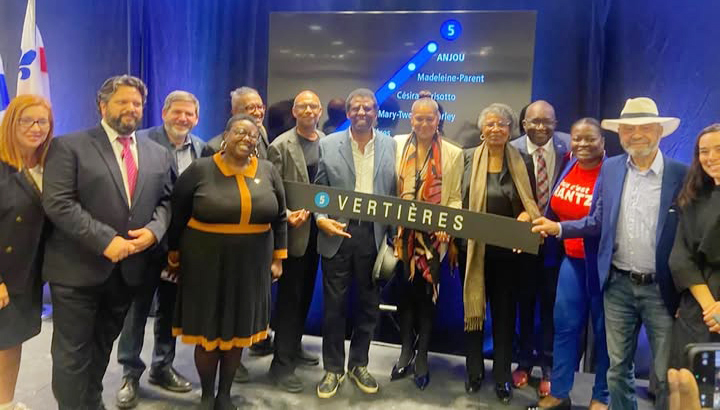
Montreal — Mayor Valérie Plante has unveiled the names of five stations on the long-awaited Blue line extension to the city’s east end—an act of civic naming that does more than guide riders. It recognizes the people and movements that built Montreal, with a special nod to communities whose stories have often lived outside the spotlight.
At the heart of that symbolism is Station Vertières, named for the 1803 Battle of Vertières, the decisive victory that led to Haiti’s independence. Set at Jean-Talon Street East and Pie-IX Boulevard, the station is explicitly a tribute to Montreal’s Haitian community, which for decades has made its home—its churches, businesses, music, and newspapers—in neighborhoods like Saint-Michel. Putting “Vertières” on the city map is more than commemoration; it’s a message that Haitian history and Montreal’s identity are inseparable.
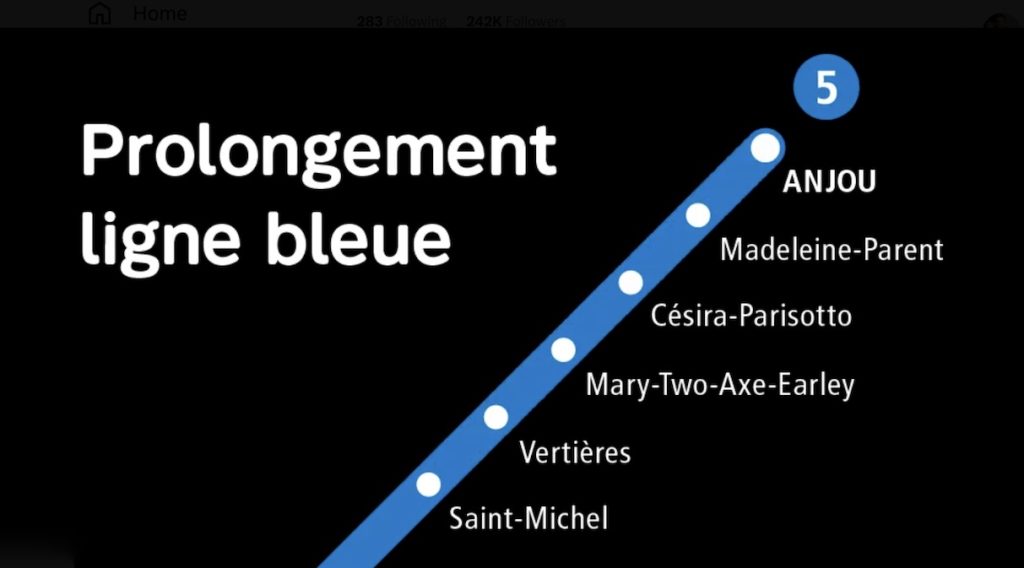
The other stations likewise root the extension in the lived experiences of Montreal’s diverse residents: Mary Two-Axe-Earley, honoring the Mohawk women’s rights advocate from Kahnawake whose fight for equality resonates across Indigenous communities; Césira-Parisotto, recognizing an Italian-Canadian nun who founded schools and a hospital and embodies immigrant traditions of mutual aid and education; Madeleine-Parent, paying tribute to the union leader and feminist whose organizing helped secure fairer workplaces for generations of newcomers and native-born workers alike; and Anjou, named for the eastern borough that anchors the line’s terminus and ties the extension to the people it will serve daily.
Why This Matters to Haitian Montrealers
For Haitian Montrealers, “Vertières” is a bridge between memory and mobility. The name threads the courage of 1803 into the routines of daily life—visible on station signage, audible in announcements, and spoken by schoolchildren navigating the network. It affirms that the history of Black liberation belongs in Montreal’s most public spaces, not only in classrooms or cultural festivals. Placed in the city’s east end—where many immigrant families begin their Montreal story—it conveys a clear message: belonging is not conditional; it is built into the civic fabric.
The symbolism is practical as well as emblematic. The Blue line extension is designed to serve the east end, where longstanding transit gaps have shaped employment prospects, commutes, and access to services. Naming stations for figures and communities who struggled for recognition, rights, and dignity transforms the extension into a rolling civics lesson: the map itself declares, you are seen here.
In a city defined by migration, each stop contributes to a larger narrative of Montreal—how newcomers make neighborhoods, and how neighborhoods, in turn, make the city.
The project at a glance
The Blue line extension is a $7.6-billion project that will add roughly six kilometres of tunnel and five stations in the east end. According to the transit authority, the line won’t open before 2031. When it does, thousands of riders will move every day through spaces that double as landmarks of inclusion—with Vertières serving as a daily reminder that the Haitian quest for freedom continues to inspire a more equitable Montreal.