By Le Floridien _________
El Seibo, Dominican Republic – A Haitian woman, Lourdia Jean Pierre, sadly died after refusing to go to the hospital while in labor with her fourth child. Her death happened quietly at home in the early hours of Friday, May 9, 2025. It was a death that could have been prevented. Lourdia wasn’t suffering from a rare medical condition or a childbirth emergency that doctors couldn’t handle. She died because she was too afraid—afraid of being arrested, deported, and sent back to a struggling Haiti. She was just 32 years old.
In a modest home tucked in the rural outskirts of El Seibo, Lourdia delivered her baby alone—without doctors, nurses, or midwives. As dawn crept in, labor pains began to grip her body. Her partner, Ronald Jean, tried to persuade her to go to the hospital. But Lourdia refused. “She started feeling pain around five in the morning,” Ronald recalled, still visibly shaken. “She said she wasn’t going anywhere.”
Moments after giving birth, her strength gave out. “She gave birth… and then… she never got up again,” Ronald said, choking on his words. He dialed 9-1-1, but when help finally arrived, it was too late. Lourdia lay lifeless, her newborn still breathing in her arms. The paramedics declared her dead in the main room of their home.
She leaves behind four children—two of them still in Haiti—and a newborn, now in the care of a relative in the nearby town of Miches. “She’s keeping him until I can get back on my feet and find work,” said Ronald, whose grief is compounded by the daunting uncertainty ahead.
This is not just a story of a tragic home birth. It is the consequence of a policy-driven climate of fear that is claiming lives in silence.
She Died Because She Was Afraid of Being Deported
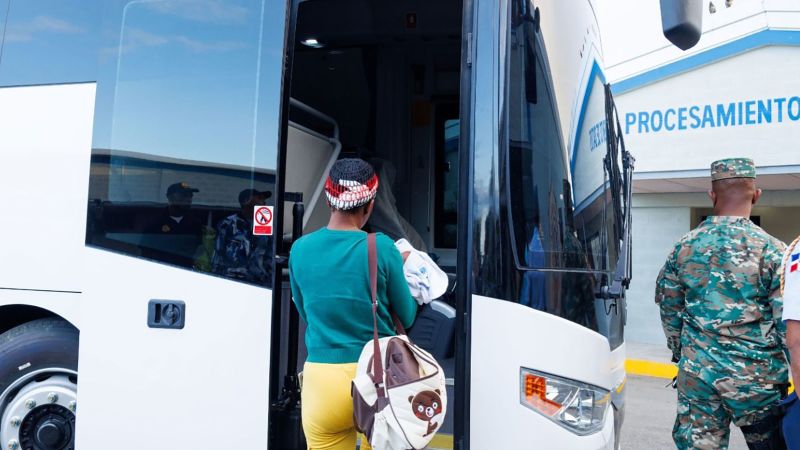
President Luis Abinader’s administration has implemented one of the harshest crackdowns on Haitian migrants in the country’s recent history. Mass deportations, identity checks in hospitals, and roadblocks targeting darker-skinned individuals have created a chilling effect—especially among undocumented Haitian women, many of whom work in agriculture or domestic labor and live in constant fear of detection.
In theory, Dominican authorities assert that emergency medical care is accessible to all, regardless of status. In practice, reality tells another story. Migrants, particularly pregnant women, often face hostile questioning in emergency rooms. Rumors and confirmed incidents of hospital staff collaborating with immigration authorities fuel the panic.
Lourdia’s decision to stay home, to give birth on a thin mattress with no professional help, was not made in ignorance. It was made in fear.
Despite the gravity of the tragedy, Lourdia Jean Pierre’s death has gone largely unreported in Dominican media. Her story, like many others, remains hidden from the national conversation. However, the nonprofit organization AfroResistance broke that silence on social media. On Mother’s Day, they published a powerful banner on their Facebook page denouncing the ongoing mistreatment of Haitian migrants. The message read: “DEPORTATIONS IN DELIVERY ROOM; A HUMAN RIGHT CRISIS IN THE DOMINICAN REPUBLIC.” That message reflects a harsh reality: pregnant and postpartum Haitian women are being detained in public hospitals and deported to Haiti—sometimes even along with their newborns. With those few words, AfroResistance exposed the cruelty of a system that criminalizes motherhood and turns childbirth into a life-threatening act of resistance.
Her story echoes across bateyes and border towns where Haitian lives hang in the balance—not because they lack knowledge or courage, but because policies have made it deadly to seek basic human rights like medical care.
A Humanitarian Crisis, Not Just a Migration Issue
Lourdia’s case is not isolated. Human rights groups have been sounding the alarm for months, warning that the Dominican Republic’s intensified anti-Haitian stance is endangering lives—especially those of women and children.
The irony is cruel: while the Dominican Republic depends on Haitian labor to fuel its agricultural and construction sectors, the very people doing that work are being stripped of their humanity, dignity, and right to safety.
In the heart of El Seibo, a newborn now sleeps without a mother. And an entire community mourns a woman who did everything right—except dare to step into a hospital.
What Her Death Demands
Lourdia Jean Pierre’s story must not be just another number in a rising death toll obscured by immigration statistics. It must spark action—from local leaders, international allies, and Dominican society itself.
To remain silent is to condone a system that lets women bleed out in childbirth because they fear the consequences of being seen. To stay silent is to turn away from a death that was not just tragic—it was avoidable.
Until there is policy that treats Haitian migrants with dignity and humanity, there will be more Lourdias. And each one will die not just from neglect, but from a climate of fear designed to make them invisible—even in death.
Photo: A woman being returned to Haiti boards a bus in the Dominican Republic. Dominican Republic government