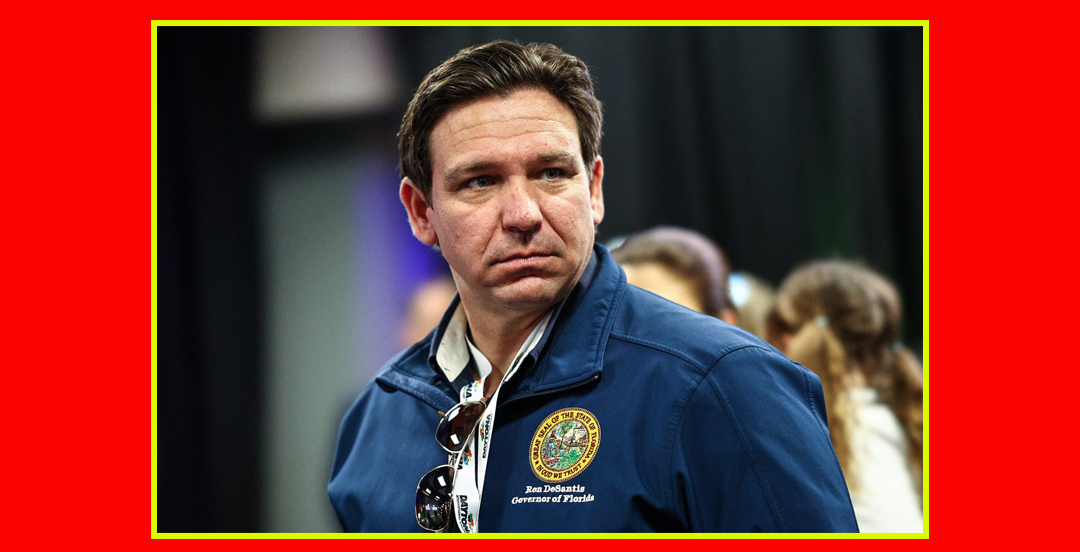
The poll shows DeSantis with a 50% approval rating, compared with 46% disapproval and 4% undecided. While those numbers keep him narrowly above water, they also reflect a governor whose influence is plateauing at a time when power in Tallahassee is beginning to shift toward the next generation of GOP leadership.
By Le Floridien Staff | January 14, 2026
As Gov. Ron DeSantis enters the final phase of his term, a new Mason-Dixon Polling & Strategy survey offers less insight into his reelection prospects—now nonexistent—and more clues about the looming battle to succeed him at the top of Florida’s Republican Party.
The poll shows DeSantis with a 50% approval rating, compared with 46% disapproval and 4% undecided. While those numbers keep him narrowly above water, they also reflect a governor whose influence is plateauing at a time when power in Tallahassee is beginning to shift toward the next generation of GOP leadership.
Compared to March 2025, when DeSantis stood at 53% approval, the three-point dip may appear modest. But the sharper decline in net favorability—from plus-11 to plus-4—tells a more consequential story. For a term-limited governor, diminishing political capital matters less for personal survival and more for shaping who comes next. In Florida politics, governors often act as kingmakers, and approval ratings can determine how much sway they hold over donors, activists, and primary voters.
The demographic breakdown suggests DeSantis’ coalition is solidifying rather than expanding—an important signal for potential successors. His strongest support remains among White voters, with 58% approval. Hispanic voters still give him a narrow plurality at 49%, but that figure has dropped eight points in a year, raising questions about whether future GOP contenders can rely on the same level of crossover appeal. Among Black voters, opposition remains overwhelming, with 84% disapproval and just 7% approval—numbers that underscore long-standing challenges for Republicans seeking broader statewide coalitions.
Gender and age splits further complicate the succession picture. DeSantis is now underwater with women voters, a bloc that will be critical for any Republican hoping to win statewide office after him. Men and older voters continue to support the Governor, but those groups alone may not be sufficient to carry a successor through a competitive GOP primary followed by a general election in an increasingly diverse Florida.
Regionally, the Governor’s strength is concentrated in traditional Republican strongholds such as North Florida and Southwest Florida. Those areas continue to anchor the GOP base, but weaker numbers in Southeast Florida point to a region that could become a decisive battleground for future Republican candidates seeking to distinguish themselves from—or align selectively with—the DeSantis legacy.
Perhaps the most telling finding for succession politics is the Governor’s declining support among independent and no-party-affiliation voters. Approval among these voters has fallen ten points since last year, from 51% to 41%. For aspiring GOP leaders, that erosion serves as both a warning and an opportunity: the DeSantis model energized the base, but may leave limited room for growth among swing voters unless recalibrated.
Historically, the poll places DeSantis closer to the lower end of his tenure. His second-weakest showing since taking office contrasts sharply with his early high point in 2019, when optimism around his leadership pushed approval to 62%. That contrast matters as Republicans begin debating whether to replicate his governing style or pivot toward a new message better suited for the post-DeSantis era.
While the polling memo notes that a 50% approval rating remains respectable, the timing is critical. With DeSantis unable to seek another term, Florida Republicans are no longer asking how popular he is—but how transferable his support will be. The question now facing the GOP is whether his remaining influence can unify the party around a successor, or whether his softening numbers will open the door to a more contested and unpredictable race for Florida’s political future.
The Mason-Dixon survey was conducted January 8–12 among 625 registered Florida voters and has a margin of error of plus or minus four percentage points.