What began as a clerical error during the chaos of the Covid-19 pandemic has now evolved into a federal case with far-reaching political consequences for one of Florida’s most closely watched members of Congress. This week, a federal judge agreed to delay the arraignment of Rep. Sheila Cherfilus-McCormick, granting her additional time to finalize legal representation as she prepares to confront serious allegations tied to millions of dollars in federal emergency funds.
The delay, which pushes the arraignment to January 20, 2026, may appear procedural on the surface. In reality, it underscores the complexity and sensitivity of a case that sits at the intersection of public health funding, campaign finance, and intraparty political tensions.
Cherfilus-McCormick, a Haitian American Democrat representing one of Florida’s remaining safe blue districts, has been indicted on 15 federal counts, including accusations that she improperly retained more than $5 million in FEMA funds while serving as CEO of Trinity Health Care Services, a family-run company involved in pandemic response efforts. Prosecutors allege that after receiving an overpayment—caused by a state administrative error—she and others failed to report or return the funds, instead redirecting portions of the money toward personal expenses and her successful congressional campaign.
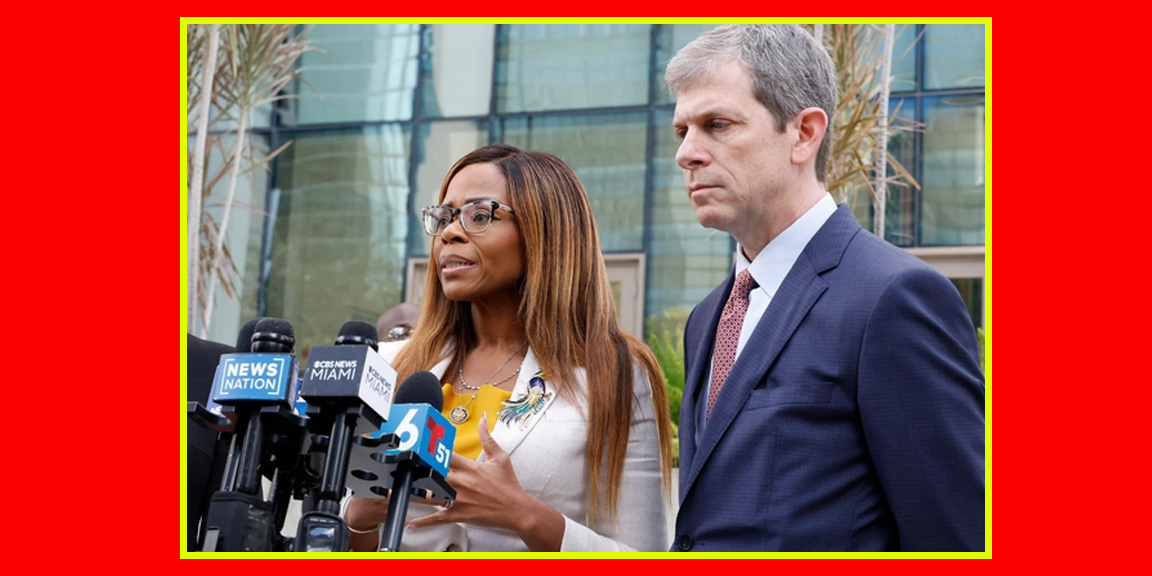
The congresswoman, however, forcefully rejects those claims. Speaking outside the courthouse, she maintained her innocence, insisting she has never stolen funds nor engaged in fraudulent conduct. Her defense team echoed that position more sharply, suggesting that the case itself may be politically motivated. David Markus, the high-profile Miami attorney she is seeking to retain as lead counsel, went so far as to allege that elements within the Florida Democratic Party may have played a role in targeting her—an accusation party leadership has declined to address publicly.
That claim adds a new and volatile dimension to the case. Cherfilus-McCormick’s rise to Congress was already unusual: she won a razor-thin Democratic primary in 2021 by just five votes following the death of longtime Congressman Alcee Hastings, then went on to secure the seat in a special election. Her victory reshaped local political alliances and placed her under intense scrutiny almost from the outset of her term.
Federal prosecutors allege that the alleged misconduct occurred before her election, but its impact has followed her into office. According to the indictment, Trinity Health Care Services provided just over $50,000 worth of legitimate pandemic-related services, yet received more than $5 million due to an overbilling error. Under federal law, contractors are required to report such overpayments. Instead, prosecutors claim, the funds were laundered, funneled through straw donations to her campaign, and partially used for luxury purchases—including a six-figure diamond ring.
The case has widened to include members of Cherfilus-McCormick’s inner circle. Her brother Edwin Cherfilus , chief of staff Nadege LeBlanc, and a tax preparer David Spencer have also been charged, reinforcing prosecutors’ contention that the alleged scheme was coordinated rather than accidental. If convicted on all counts, the congresswoman could face decades in prison.
At the same time, the indictment raises unresolved questions. Trinity had already reached a civil settlement with Florida’s emergency management agency to repay the funds over 15 years—an agreement that complicates the criminal narrative. Additionally, some of the campaign donations cited by prosecutors reportedly predate the disputed $5 million transfer, a timeline issue likely to feature prominently in the defense’s arguments.
Politically, the fallout has been swift but measured. While some Republicans have called for Cherfilus-McCormick’s removal from Congress, Democratic leaders have stopped short of that step, instead stripping her of a key leadership role on a House Foreign Affairs subcommittee while the case proceeds.
For now, Cherfilus-McCormick remains free on bond, with limited travel privileges and a public vow to fight the charges. As her legal team takes shape and the court calendar advances, the case is poised to test not only her personal defense, but broader questions about accountability, political power, and how pandemic-era decisions are judged years later.
Whether this saga ultimately proves to be a case of criminal wrongdoing, political rivalry, or systemic failure—or some combination of all three—will unfold in the months ahead. What is already clear is that the outcome could redefine both a congressional career and the boundaries between governance, emergency funding, and political ambition.