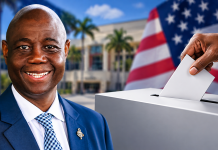
Miami-Dade Elections Department confirms the race is now unopposed, even as the incumbent mayor prepares an appeal and seeks another opportunity to run.
By Le Floridien | October 20, 2026*
NORTH MIAMI, FL — What began as a legal dispute over the method used to pay election qualifying fees has now dramatically changed the race for mayor of North Miami. Incumbent Mayor Alix Desulme has been disqualified from the November 3, 2026, election, leaving his sole remaining opponent, George E. Duell Morgan, legally deemed elected under the current ruling.
The development became official for election administration purposes when Miami-Dade County issued a formal Notice to Voter, informing residents that the mayoral contest is now an unopposed race and that voting in the contest will not change its outcome.
The notice follows a ruling delivered Monday, October 19, by Miami-Dade Circuit Judge Beatrice Butchko Sanchez, who determined that Desulme failed to satisfy the legal requirements for paying his candidate qualifying fees.
For North Miami residents, the consequences are extraordinary: a mayoral contest originally expected to be decided at the ballot box has effectively been settled by a court ruling, subject to any further judicial intervention.
County Issues Official Notice: The Race Is Unopposed
The Miami-Dade County Elections Department has issued an unusually consequential announcement to North Miami voters.
The notice states: “A candidate in the race for the office of North Miami – Mayor has been disqualified resulting in an unopposed candidate race.”
It further explains that votes cast in the mayoral contest cannot change the result because the remaining candidate is legally deemed elected.
In practical terms, the notice means that George Morgan, as the remaining qualified candidate, does not need to obtain a majority of votes—or even win a competitive vote count—to secure the office under the current legal circumstances.
Although Desulme’s name may still appear on ballots printed before the court’s ruling, votes cast for him cannot reverse the disqualification or change the outcome under the existing decision.
The distinction is important. The notice does not necessarily mean that ballots containing a vote for Desulme will be rejected or that those voters’ selections in other races will be affected. It specifically addresses the legal effect of voting in the North Miami mayoral contest.
Unless a higher court intervenes or another ruling changes the candidates’ legal status, Morgan remains the only qualified candidate and is deemed elected under the notice.
How Two Cashier’s Checks Led to the Mayor’s Disqualification
The legal battle centers on the way Desulme paid the qualifying fees required to seek reelection.
According to court proceedings and published reports, Desulme submitted two bank-issued cashier’s checks from TD Bank totaling approximately $5,392.80.
The problem was not simply whether sufficient money existed to cover the payment. Rather, it concerned the legal form of the payment and whether it complied with Florida’s election requirements.
Florida law requires candidates subject to the qualifying-fee provisions to make payment using funds from their campaign accounts, with the applicable requirements concerning campaign checks and the campaign treasurer’s signature.
Morgan challenged Desulme’s qualification, arguing that the bank-issued checks did not satisfy those requirements.
Desulme’s legal team maintained that the funds came from his campaign account and therefore fulfilled the essential purpose of the law.
During earlier proceedings, attorney Benedict Kuehne argued that the payment was made with legitimate campaign funds, despite being issued in the form of a cashier’s check.
The judge ultimately sided with Morgan.
On October 19, Judge Butchko Sanchez ruled that Desulme must be disqualified as a candidate for mayor.
The decision demonstrates how election qualification requirements can carry consequences extending far beyond paperwork. Even where a candidate maintains that the correct funds were used, failure to comply with a legally required payment procedure can result in exclusion from an election.
George Morgan’s Path to City Hall
For George E. Duell Morgan, the ruling represents a remarkable change in political circumstances.
Morgan entered the contest as a challenger seeking to unseat an incumbent mayor through the November 3 election.
Instead, his successful legal challenge has left him as the only remaining qualified candidate, according to the county’s election notice.
Under the current circumstances, Morgan is legally deemed elected without having to defeat Desulme in a head-to-head vote.
This does not mean Morgan has already taken office. The formal transition and assumption of mayoral duties remain separate from his status as the candidate deemed elected.
The distinction also means that Morgan’s position is not based on a projected election victory, opinion polling or the counting of votes. It is based on the county’s application of election law following Desulme’s court-ordered disqualification.
For now, the November 3 mayoral contest is no longer a competitive race.
Desulme’s Legal Battle Is Not Over
Despite the county’s announcement, Desulme has not abandoned his effort to challenge the disqualification.
Following Monday’s decision, his attorneys announced plans to appeal the ruling.
On Tuesday, October 20, Local 10 News also reported that Desulme had filed a counterclaim asking the court to reopen the qualifying period for a proposed special mayoral election on December 1.
His legal arguments include the position that he paid the required fees using campaign funds and that disqualification on the basis of the payment instrument unfairly prevents voters from choosing between the candidates.
Desulme has also challenged Morgan’s own qualification, alleging that his opponent’s qualifying payment was 80 cents short of the required amount.
That allegation is separate from the court’s ruling disqualifying Desulme. It should not be treated as an established finding that Morgan was improperly qualified.
Whether Desulme can obtain emergency relief, reverse the disqualification on appeal, or secure another election remains unresolved.
Importantly, filing an appeal does not automatically erase the ruling or restore Desulme’s status as a qualified candidate. A court would have to grant appropriate relief for the current legal consequences to change.
As of October 20, the county’s notice continues to describe the contest as unopposed.
A Larger Question About Election Administration
Beyond the immediate political consequences, the case raises an important question about the responsibilities of municipal election officials.
When a candidate presents qualifying documents and pays the required fees, how far should the city clerk’s office go in identifying possible errors before the qualifying deadline expires?
Election officials generally perform administrative duties governed by statute and local rules. The responsibility to comply with candidate qualification requirements ultimately rests with the candidate.