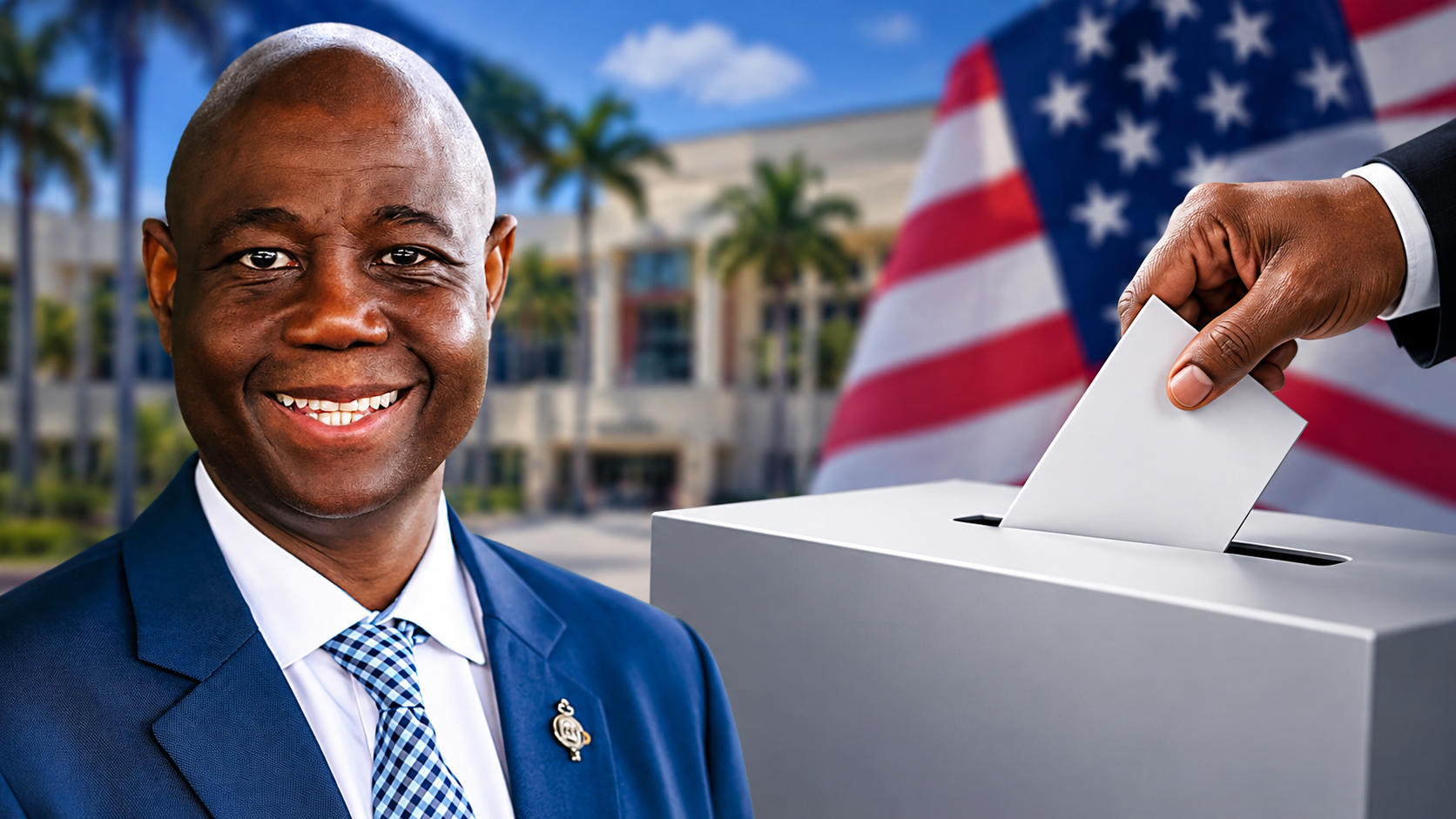
Two TD Bank official checks totaling $5,392.80 raise questions about whether North Miami Mayor Alix Desulme complied with Florida election law when paying his qualifying fees. With the November 3 election approaching, could a payment issue put his place on the ballot at risk?
By Le Floridien Staff
NORTH MIAMI, FL — With less than a month before North Miami’s municipal election, Mayor Alix Desulme’s reelection candidacy is facing questions over the method used to pay his qualifying fees.
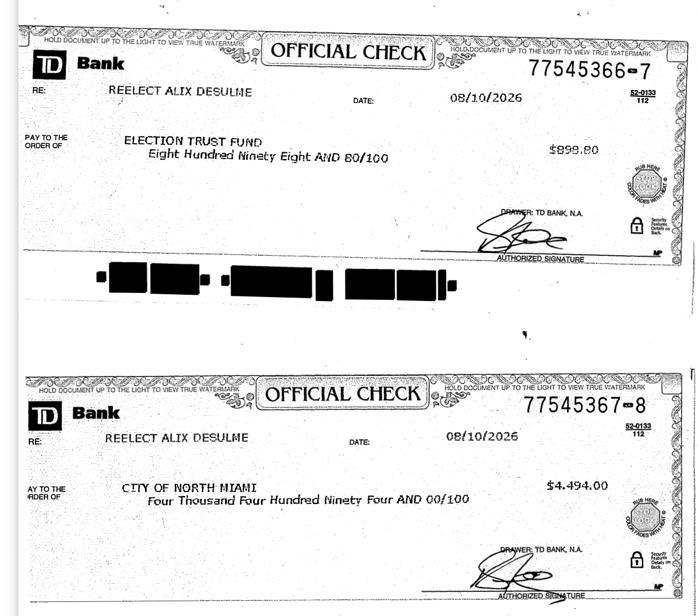
Documents reviewed by Le Floridien show two TD Bank checks labeled “OFFICIAL CHECK,” both dated August 10, 2026, and bearing the reference “REELECT ALIX DESULME.”
One check, numbered 77545366-7, was made payable to the Election Trust Fund for $898.80. The second, numbered 77545367-8, was issued to the City of North Miami for $4,494. Together, the payments total $5,392.80, matching the qualifying fees required for mayoral candidates.
The documents appear to show bank-issued checks rather than ordinary checks drawn directly from a campaign account. That distinction could be legally significant under Florida election law.
What Florida law says — and why previous court rulings matter
Florida Statute 99.061(7)(a)1 generally requires candidates to pay their qualifying fees with a properly executed check drawn from their designated campaign account. The law permits a cashier’s check under limited circumstances, including when an original campaign check is returned by the bank and replaced within the qualifying period.
In 2024, Florida’s Fourth District Court of Appeal upheld the disqualification of Riviera Beach City Council candidate Julie Botel, who had submitted a cashier’s check instead of the required campaign-account check.
The ruling in Spiritis v. Botel established that the statutory payment requirement applies to municipal candidates covered by the law.
A more recent controversy unfolded in North Miami itself. In September 2026, Circuit Judge Christopher Green upheld the disqualification of City Council candidate Hector Medina because his qualifying checks had been signed by the wrong person.
Although the City Clerk’s Office had initially accepted and cashed Medina’s checks, the court determined that the qualifying requirements had not been satisfied.
The two cases involved different defects, but both illustrate that accepting a candidate’s payment does not necessarily establish legal compliance.
Under Florida election procedures, the qualifying officer’s duties are largely ministerial. Candidates bear responsibility for ensuring that their submissions meet the applicable legal requirements.
What could happen to Desulme’s candidacy?
The two checks associated with Desulme’s campaign were dated August 10, the opening day of North Miami’s qualifying period, which ended August 20.
The two TD Bank checks raise questions about whether Desulme followed Florida election law when paying his qualifying fees. Both are labeled “OFFICIAL CHECK,” rather than appearing to be checks drawn directly from his campaign account, as generally required by law.
Florida courts have previously disqualified candidates for failing to follow qualifying payment requirements, even when election officials initially accepted their checks. However, whether the same legal consequences could apply to Desulme remains uncertain and would depend on whether his payments violated the law.
As of October 9, the City of North Miami still officially lists Mayor Alix Desulme as a qualified candidate, and no formal disqualification has been announced.
However, with the November 3 election approaching and Florida courts having previously disqualified candidates over qualifying payment irregularities, one important question remains: Could the way Desulme paid his election fees ultimately cost him his place on the ballot?