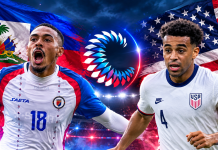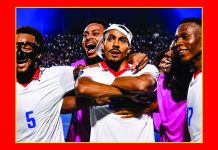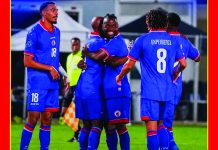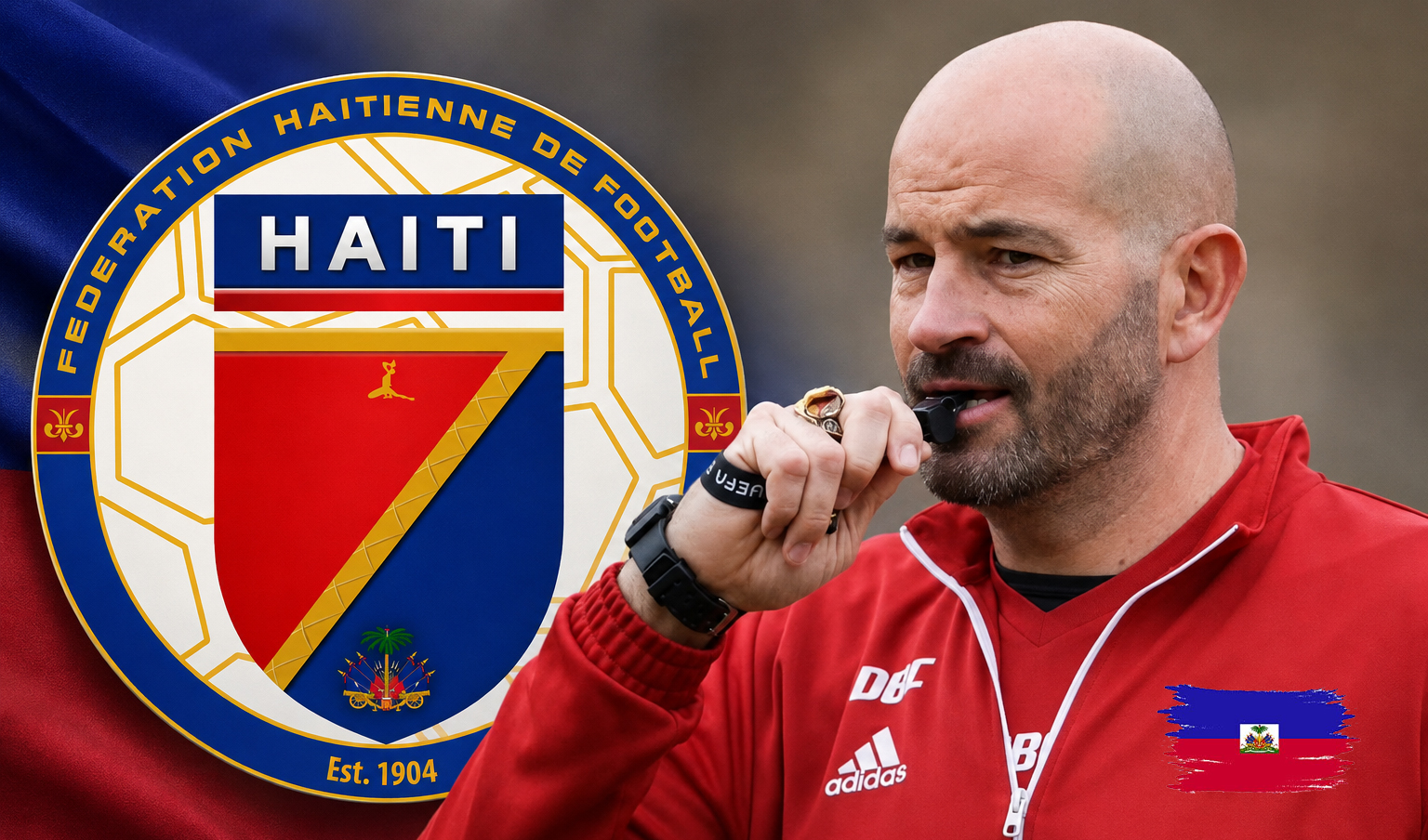
The Haitian Football Federation has appointed Spanish coach David Badía, a former FC Barcelona youth coach, to replace Sébastien Migné at the helm of the Grenadiers. While Badía has no previous senior national-team or Concacaf coaching experience, his extensive background in European football could prove valuable for a Haitian squad increasingly built around players developed and competing in Europe. With the Concacaf Nations League approaching, he faces an immediate challenge: quickly understanding his new team, establishing a tactical identity and making the most of Haiti’s growing pool of diaspora talent.
By Le Floridien
The Haitian national team is entering a new era.
The Haitian Football Federation has selected Spanish coach David Badía Cequier to succeed Sébastien Migné at the helm of the Grenadiers, handing the 51-year-old European coach the responsibility of building on Haiti’s recent progress while preparing the team for its next major challenges. Badía arrives with considerable experience in European club football, but with an important question hanging over his appointment: How quickly can a coach who has never managed a senior national team — and has no established background in Haitian or Caribbean football — understand the particular realities of the Grenadiers?
It is a legitimate question, but there is another side to the appointment that deserves attention. Although Badía may have much to learn about Haiti, he is entering a national team whose talent pool increasingly comes from the European football system he knows well. That could prove to be one of his greatest advantages.
A Coach Formed in the European System
Born in Gavà, Catalonia, Badía holds a UEFA Pro Licence and spent four seasons, from 2012 to 2016, working in the youth system of FC Barcelona, one of the world’s most respected environments for player development. He also served as director of Barcelona’s academy in Istanbul. His professional profile identifies the 4-2-3-1 as his base system and emphasizes technical quality, tactical organization and the construction of cohesive teams.
His career subsequently took him through several European football cultures.
Badía worked in Turkey with Antalyaspor and later Fenerbahçe, and in Spain as an assistant with Almería. He then moved into head-coaching positions in Cyprus with Ethnikos Achna, AEK Larnaca and Akritas Chlorakas, before coaching Lechia Gdańsk in Poland. His most recent position was another spell with Ethnikos Achna during the 2024-25 season.
One of the notable accomplishments on his résumé came at AEK Larnaca, which earned qualification for the UEFA Champions League qualifying rounds during his tenure. His career therefore reflects extensive exposure to European professional football, even if it does not carry the profile of a coach who has spent years managing at Europe’s biggest clubs.
The FHF’s decision is consequently something of a calculated bet: hiring a coach whose experience is primarily European and club-based to lead a national team with increasingly European characteristics.
He May Not Know Haiti Yet — But He Knows Europe
Badía’s biggest initial weakness is obvious.
There is no significant evidence in his professional record of previous work in the Caribbean or Concacaf. Nor has he previously served as the head coach of a senior national team. The rhythm of international football — limited training sessions, players arriving from different clubs and countries, long-distance travel and the pressure to obtain results almost immediately — will therefore represent a new challenge.
But Haiti itself has changed.
The Grenadiers are no longer a national team built primarily around players developed inside Haiti. A substantial portion of the country’s strongest talent is now developed and employed abroad, particularly in Europe.
France remains especially important because of the large Haitian diaspora and the enormous French football-development system. England has also become increasingly relevant, while Haitian internationals and potential internationals can be found throughout Belgium, Switzerland, Portugal, the Netherlands and other European leagues.
This creates an unusual situation.
Badía may not yet know Haitian football particularly well, but he knows the football environment where many of Haiti’s best players earn their living.
That distinction could become central to whether his appointment succeeds.
Haiti’s European Talent Pool Must Become a Priority
One of Badía’s most important responsibilities should extend beyond coaching the players already wearing the Haitian jersey.
Haiti must continue identifying players of Haitian descent developing in Europe — particularly in France, but also in England, Belgium and elsewhere — who may be eligible to represent the country.
For a nation with Haiti’s limited domestic football infrastructure, the diaspora is not simply an additional source of players. It has become one of the country’s most valuable sporting resources.
There are young footballers of Haitian heritage passing through European academies and professional systems who could potentially strengthen the Grenadiers. Some are already known. Others may still be outside the federation’s immediate radar. And some dual-national players may have several international possibilities available to them.
Identifying them is only the beginning.
The FHF and its new coach must be able to present those players with a convincing sporting project: a national team that is professionally organized, competitive and capable of providing them with meaningful international opportunities.
Badía’s European background could help in that regard. He has spent years working within European football and lists Spanish, English, German, Turkish and Catalan among the languages he speaks. Those connections and that familiarity with the European game could make communication with clubs, agents and players easier.
But recruiting talent is one thing. Building a team is another.
From Individual Talent to Collective Strength
Haiti’s challenge has rarely been simply a lack of talented footballers.
The more difficult question is whether those individual talents can be transformed into a disciplined and consistent national team.
Players arrive from different leagues, different coaching philosophies and different football cultures. Some were born in Haiti; others grew up abroad. Some speak French or Creole; others may be more comfortable communicating in English or another European language.
The national-team coach must turn those differences into strength rather than fragmentation.
This is where Badía’s reputation as a coach concerned with organization and collective structure will be tested.
His professional profile describes the 4-2-3-1 as his preferred base formation. Such a system could represent a noticeable tactical adjustment from the approach frequently used under Migné, particularly in attack.
Haiti has several established center-forward options. Duckens Nazon, Frantzdy Pierrot, Wilson Isidor, Lenny Joseph and Yassin Fortuné were among the attacking choices available during the previous cycle. If Badía regularly uses only one central striker, competition for places could become intense.
That is not necessarily a problem.
Competition can raise standards. Reputation should not guarantee selection. Playing time, current club form, tactical compatibility and commitment to the national team should matter.
Badía will therefore have some difficult decisions to make very quickly.
Almost No Time for a Honeymoon
Perhaps the greatest problem facing the new coach is time.
The fifth edition of the Concacaf Nations League begins in September, and Haiti has been drawn into League A, Group A alongside Costa Rica, Trinidad and Tobago, Curaçao, Nicaragua and the Dominican Republic. Each team will play four group-stage matches, with only the top two advancing to the quarterfinals.
Haiti’s schedule gives Badía an immediate examination.
The Grenadiers are scheduled to face Trinidad and Tobago on September 24, followed by Costa Rica on September 27. They will then meet the Dominican Republic on October 1 before facing Costa Rica again on October 4.
There is little room for experimentation.
Badía has approximately one month to study his available players, communicate with them and their clubs, determine his first squad, introduce his tactical philosophy and prepare for competitive matches.
And those matches matter beyond the Nations League itself.
The 2026-27 competition will serve as the qualification pathway toward the 2027 Concacaf Gold Cup, giving Haiti another reason why this transition cannot be treated simply as the beginning of a long rebuilding project.
Badía must build for tomorrow while winning today.
A Different Kind of Test for the FHF
The appointment also places responsibility on the Haitian Football Federation.
A national coach cannot succeed through tactics alone. He needs scouting, video analysis, medical coordination, reliable travel arrangements, communication with European clubs and an organized system for following eligible players abroad.
If Haiti intends to take full advantage of its diaspora, scouting cannot occur only when an important tournament approaches.
The federation needs a permanent network capable of tracking Haitian and Haitian-eligible players from youth academies through senior professional football. France deserves particular attention because of the depth of its football system and the size of the Haitian community there, but scouting must extend throughout Europe and North America.
Badía should be part of that structure, not expected to replace it.
That distinction is important. A coach can identify needs and recommend players, but building a sustainable international scouting network is ultimately an institutional responsibility.
The Challenge Ahead
Ultimately, Badía’s success will depend on how quickly he can adapt his European experience to the particular realities of the Haitian national team.
His task is clear: establish a disciplined tactical identity, strengthen relationships with Haiti’s European-based professionals and help identify additional players of Haitian descent who could strengthen the Grenadiers. His European background could prove valuable, but only results will determine whether the FHF made the right choice.
Badía will have little time to make his mark. September 24 against Trinidad and Tobago will provide the first indication of what this new era may bring.