By Le Floridien Staff
Based on reports from Chilean media
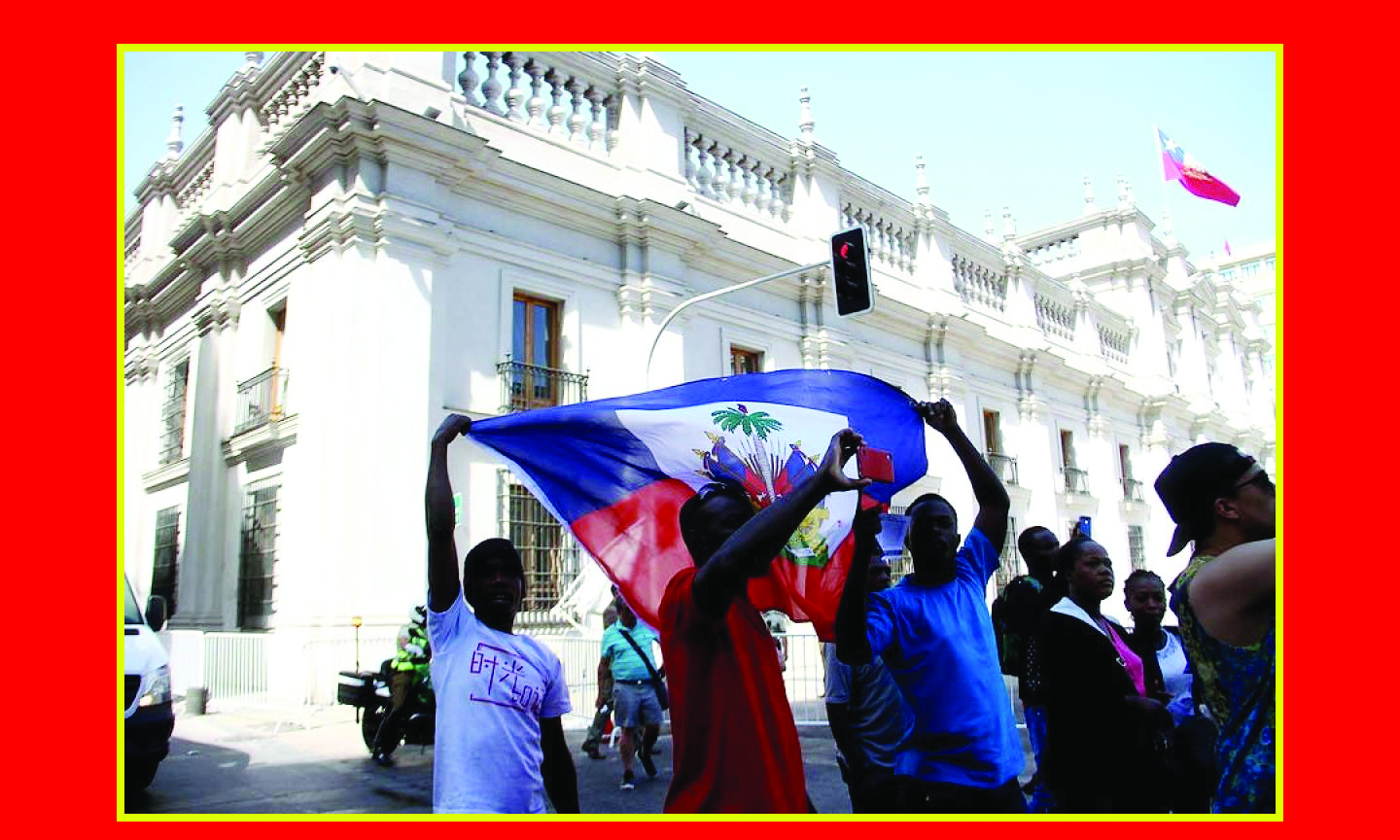
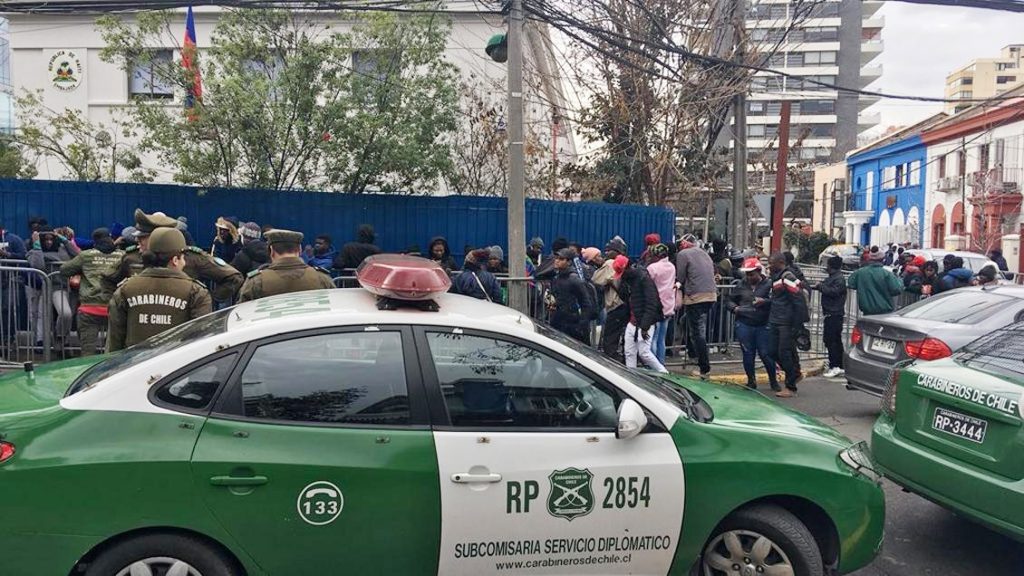
SANTIAGO, Chile — Hundreds of Haitian immigrants gathered outside Haiti’s Embassy in Santiago on Saturday, August 22, in a dramatic protest over long delays, alleged excessive fees and difficulties obtaining critical documents needed to regularize their immigration status in Chile.
What began as a large gathering of frustrated applicants eventually turned tense. After hours of waiting and what protesters described as a lack of clear information from consular officials, some demonstrators forced their way through the entrance of the diplomatic compound, damaging the main door and prompting Chilean police, known as Carabineros, to intervene.
Local media estimated that approximately 500 to 600 people had gathered around the embassy during the protest.
At the center of the dispute is a document that has become critically important for many Haitians living in Chile: the criminal-record certificate, or certificado de antecedentes penales, from their country of origin.
Chile’s National Migration Service, known as SERMIG, requires the document in certain immigration proceedings, including cases involving permanent residency. Haitians interviewed by Chilean media said difficulties obtaining the certificate have left some of them unable to complete their immigration applications despite having lived in Chile for years.
Haitians Say Delays Are Putting Their Lives on Hold
For affected immigrants, the problem extends far beyond obtaining a piece of paper.
Without the necessary documentation, some Haitians say they cannot regularize their immigration status or obtain access to employment opportunities. Protesters also expressed fears about receiving orders requiring them to leave Chile.
One Haitian interviewed by Radio Cooperativa said there are people who arrived in Chile eight, nine or even ten years ago who still struggle to get their immigration documents in order.
David Antoine, spokesperson for the Haitian Community in Chile, said problems intensified following changes in how Chile’s immigration authorities handled some pending applications.
According to Antoine, some immigration cases that had already progressed to an advanced stage were moved backward in the process following a change in criteria at SERMIG.
Confusion surrounding Saturday’s activities at the embassy appears to have further fueled the frustration. Antoine told Chilean media that many Haitians arrived believing the embassy would be processing criminal-record certificates that day. Instead, according to his account, officials were conducting training involving only a limited group.
As the hours passed without sufficient information reaching the large crowd outside, tensions escalated.
Some protesters eventually pushed through the embassy’s entrance in an effort to speak with consular officials. Police were deployed to restore order.
Antoine publicly expressed regret over the incident, describing what happened at the diplomatic mission as troubling and embarrassing, while also emphasizing the desperation underlying the protest.
Allegations of Excessive Fees and Invalid Documents
Perhaps the most troubling allegations concern the amount of money some Haitians say they have paid trying to obtain their documents.
Several Chilean news organizations reported complaints about payments ranging into the hundreds of thousands of Chilean pesos.
ADN Radio reported allegations that intermediaries charged between 300,000 and 500,000 Chilean pesos — roughly $325 to $550 U.S. dollars — to obtain or facilitate criminal-record certificates.
Some applicants claimed that after paying large amounts, the documents they received were already expired, were rejected or never arrived.
Other reports cited different amounts allegedly charged through various channels, underscoring the lack of clarity surrounding the process.
The allegations of excessive charges and possible scams have not been established as wrongdoing by the Haitian Embassy itself. Some of the complaints specifically concern outside intermediaries operating around the document-processing system.
Follow-up reporting by Radio Cooperativa on Monday, August 24, said Haitians continued gathering outside the embassy. Applicants interviewed by the station described a complicated process in which fingerprints are taken in Chile but verification of criminal records ultimately depends on authorities in Haiti.
Some applicants told the station that resolving their documentation problems can take years.
Passport Delays Also Reported
The criminal-record certificates are not the only concern.
Haitian immigrants interviewed by Chilean media also complained about lengthy delays in obtaining passports, with some alleging waits lasting several years.
Together, the complaints paint a broader picture of a diaspora community caught between the administrative requirements of the country where they live and the difficulty of obtaining official documentation from their country of origin.
For Haitians who have established families, jobs and lives in Chile, those delays can have serious consequences.
Antoine said lack of regular immigration status contributes to poverty, discrimination and violations of immigrants’ rights. He also emphasized the economic connection between the diaspora and Haiti, noting that many Haitians living in Chile financially support relatives back home.
A Crisis That Goes Beyond Saturday’s Protest
The images of Haitians forcing their way into their own country’s diplomatic mission attracted attention, but the events in Santiago also raise broader questions about how effectively Haiti’s diplomatic and consular network is serving a population that has become increasingly dispersed around the world.
For members of the Haitian diaspora, passports, birth certificates, criminal-record certificates and other official documents are not merely administrative paperwork. They can determine whether someone can obtain legal residency, work, travel or maintain lawful status in the country where they have rebuilt their life.
The Santiago protest therefore reflects something larger than one chaotic Saturday outside an embassy.
It illustrates the vulnerability Haitian migrants can face when the documents required by their host country depend on an administrative system thousands of miles away in Haiti.
As of Monday, August 24, Chilean media reported that Haitians were still gathering outside the embassy seeking their criminal-record certificates, although the situation was peaceful. Carabineros maintained a police presence around the diplomatic mission to prevent further disturbances.
For hundreds of Haitian families in Chile, however, the fundamental problem remains unresolved: obtaining the documents they need to secure their immigration status and continue the lives they have built far from Haiti.
Sources: El País Chile, ADN Radio Chile, Radio Cooperativa, TVN Chile, BioBioChile and Diario Universidad de Chile.