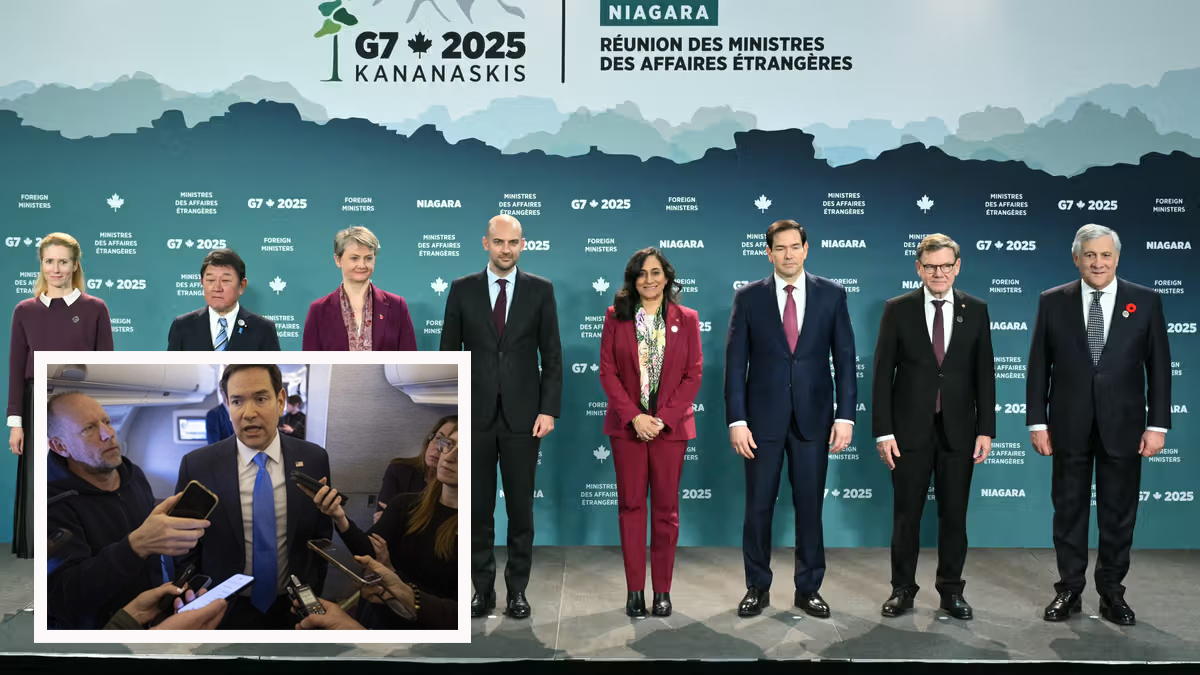
HAMILTON, ONTARIO (Le Floridien) — Speaking to reporters after a meeting of the Group of Seven (G7) foreign ministers, U.S. Secretary of State Marco Rubio outlined a detailed roadmap for advancing the international gang-suppression initiative in Haiti—while emphasizing that the United States cannot bear the mission’s weight by itself.
“We have two challenges in Haiti,” Rubio said, describing what he called the “transition period” of the new international force tasked with reclaiming control from entrenched criminal gangs. He noted that Washington has already pledged to cover the first half of the transition phase, which runs through the end of this calendar year. However, he urged other nations to fund the remaining months and contribute troops to the mission.
Rubio outlined three unresolved priorities that must be addressed to ensure the mission’s success:
-
Financing the final months of the transition period.
-
Funding the long-term operations of the gang-suppression force and its supporting United Nations office.
-
Securing troop commitments to expand the deployment from the 2,000 Kenyan soldiers currently engaged to a target strength of 5,000 multinational personnel.
“We can’t just have the Kenyans doing it alone with 2,000 troops,” Rubio said. “There’s a lot of work to be done. We work on it every single day.”
While commending Canada’s contribution, Rubio appealed to countries in the Western Hemisphere to take a more active role in the mission, underscoring that Haiti’s crisis is not just a Caribbean issue, but a regional responsibility.
“It really is something that we’d like to see higher levels of participation from our hemisphere,” he said.
When asked whether another nation is prepared to assume leadership of the mission from the Kenyan contingent, Rubio said no single country has been designated but emphasized that “other countries will join it” and that shared leadership remains the ultimate goal.
“It won’t just be the Kenyans by themselves,” he added.
Rubio characterized the mission as both urgent and essential, calling Haiti’s situation “a hemispheric challenge.” With escalating violence, political paralysis, and weakened institutions, the secretary framed the multinational force as critical to preventing total state collapse and restoring a measure of stability.
His remarks come amid mounting international concern over Haiti’s security vacuum. Earlier this year, the United States designated two of Haiti’s most powerful gang coalitions—Viv Ansanm and Gran Grif—as foreign terrorist organizations, citing their domination of large urban areas and their role in widespread kidnappings, killings, and displacement of civilians.
Despite the urgency, Rubio acknowledged that the plan’s success still hinges on greater global participation. The G7 discussions in Hamilton produced no new immediate commitments of troops or funding, according to U.S. officials present at the meeting—a reality that underscores the steep diplomatic and logistical challenges ahead.
For Haiti, the stakes could not be higher. A U.N. Security Council resolution passed in late September authorized the creation of a new multinational support force of over 5,000 personnel to reinforce the country’s struggling police and security institutions. Yet experts warn that without predictable funding, coordination, and sustained troop contributions, the mission risks faltering before achieving meaningful results.
Rubio’s emphasis on “finishing the transition” and “raising money for the UN office and the gang-suppression force” reflects a broader shift in U.S. strategy—from emergency stabilization to the establishment of a sustainable international security framework. Still, success depends heavily on whether other nations are willing to contribute both resources and personnel.
For many in the Haitian-American community, Rubio’s remarks carry a mixture of hope and caution. The United States’ renewed engagement offers a pathway toward stability and governance reform in Haiti—but its success will depend on the collective will of the international community to act decisively and remain committed long after the headlines fade.