Overview
Haiti is facing a deepening humanitarian crisis driven by gang violence, hunger, and mass displacement, with more than 6.4 million people now in need of urgent assistance, according to the United Nations. As insecurity spreads and basic services collapse, women and children are suffering the most, while the humanitarian response remains dangerously underfunded. The UN warns that without immediate international action, the crisis will grow even worse.
By Le Floridien staff
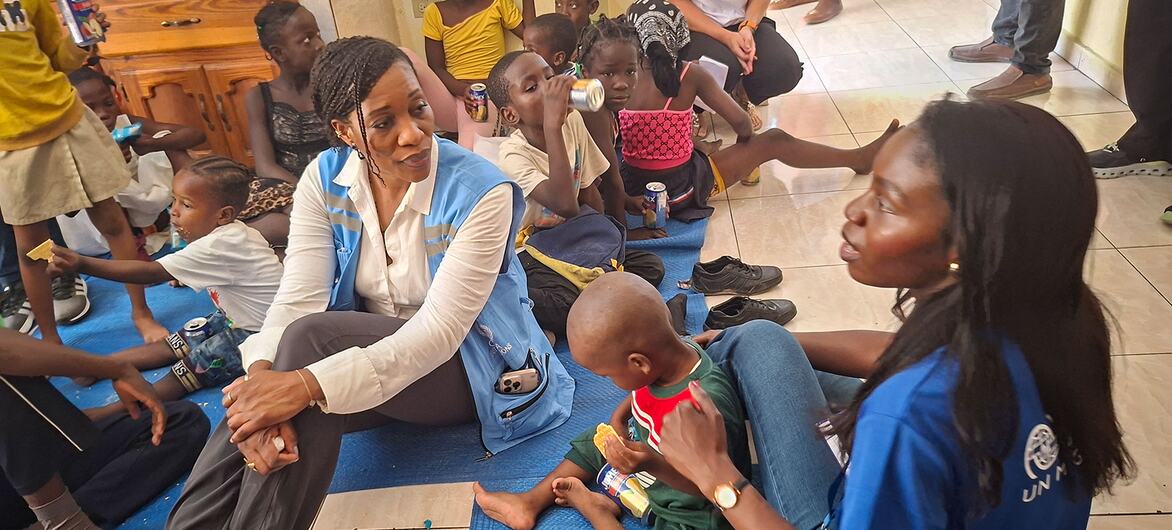
A teenage girl stands in a displacement camp, holding her three-month-old baby. She is alone, separated from her family, with no knowledge of their whereabouts. Nearby, children sleep on bare ground in overcrowded shelters, exposed to vermin and skin infections. Families skip meals to survive. Schools remain shuttered. Women and girls endure unspeakable violence. Entire neighborhoods exist under the constant threat of armed gangs.
This is not a distant conflict zone. This is Haiti today—at the heart of the Caribbean, just miles from the United States, one of the most powerful nations in the world.
The United Nations has sounded a stark warning: Haiti’s crisis is rapidly intensifying. More than 6.4 million people, over half the population, now require humanitarian assistance, while 5.7 million face acute food insecurity. These figures are not abstractions; they represent millions of lives destabilized, families fractured, and a nation pushed to the brink of collapse.
Haiti is no longer confronting a temporary crisis. It is experiencing a profound humanitarian breakdown that demands urgent and sustained international attention.
A Nation Trapped by Violence and Displacement
Armed violence continues to suffocate large parts of the country, particularly the capital. According to the United Nations, nearly 90 percent of Port-au-Prince, Haiti’s political and economic center, is under gang control. Residents in these areas face daily insecurity, with limited freedom to work, travel, or access basic services.
The crisis extends well beyond the capital. In Haiti’s Centre Department, a recent surge of violence left approximately 80 people dead and forced more than 13,000 others to flee. Across the country, displacement sites are overwhelmed with families who have lost everything. In one striking example, a school designed to accommodate 400 students now shelters nearly 2,800 displaced individuals, many of whom sleep directly on the ground.
The consequences for Haiti’s children are particularly severe. An estimated 1,600 schools remain closed due to insecurity, depriving 250,000 children of access to education. In a country where education has long been regarded as a pathway to opportunity and social mobility, this disruption represents a devastating loss for an entire generation.
Women and Children Bear the Heaviest Burden
The humanitarian crisis in Haiti has evolved into a profound protection crisis, with women and children disproportionately affected. The United Nations recorded 8,100 survivors of gender-based violence in the past year, marking a 25 percent increase compared to the previous year. Alarmingly, half of these cases involved rape, and one in six survivors is under the age of 18.
During a recent briefing, Edem Wosornu of the UN Office for the Coordination of Humanitarian Affairs (OCHA) recounted the story of a 16-year-old girl she encountered during her mission to Haiti. Displaced and separated from her family, the girl accepted help from a man who subsequently abused her. Wosornu described her as “a child holding a child,” underscoring the profound trauma inflicted on Haiti’s most vulnerable.
Access to care remains critically limited. Only 30 percent of survivors receive medical or psychological assistance within the essential 72-hour window following sexual violence, due largely to insufficient funding and limited humanitarian capacity. As a result, many victims are left without adequate treatment, protection, or support, compounding the long-term physical and psychological consequences.
Haiti Cannot Wait Any Longer
Despite extraordinary challenges, humanitarian workers continue to operate across Haiti, often at significant personal risk. Many are Haitians themselves, displaced, threatened, yet steadfast in their commitment to assist others. In some cases, aid workers must negotiate directly with armed groups to access communities in need.
However, the scale of the crisis far exceeds the available resources. The United Nations has appealed for $880 million to assist 4.2 million people in 2026. To date, less than 20 percent of that funding has been secured, leaving critical programs under-resourced at a time of escalating need.
The message from the international community is unequivocal: Haiti cannot wait. While humanitarian assistance alone cannot resolve the country’s structural challenges, the absence of immediate support will only deepen human suffering. Haiti requires not only emergency aid, but also sustained investment in security, governance, and essential services.
The international community now faces a defining choice. Haiti’s crisis is unfolding in real time, with consequences that extend beyond its borders. The window for meaningful intervention remains open, but it is rapidly closing.
The question is no longer whether Haiti needs help.
The question is whether the world will act before it is too late.