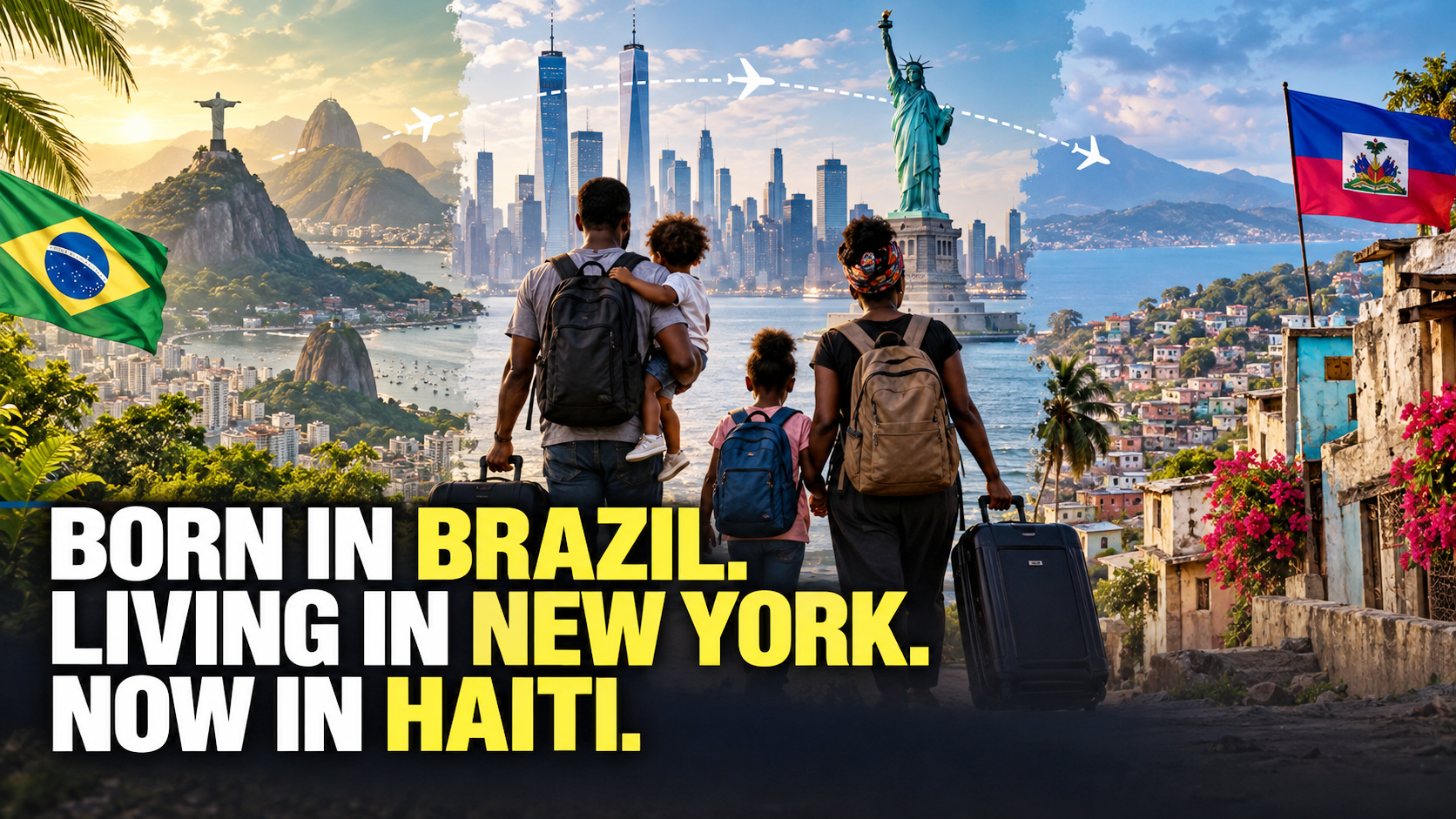
A young boy born in Brazil has been deported from the United States to Haiti alongside his Haitian parents, placing a child who was not born in Haiti in one of the world’s most dangerous humanitarian crises.
The boy, born in 2021, was among 57 people transported by the United States to Cap-Haïtien on August 27, according to information provided to the Brazilian newspaper Folha de S.Paulo by the International Organization for Migration. Human Rights Watch researcher Nathalye Cotrino, who monitored the flight’s arrival, also confirmed the child’s presence.
The family had reportedly been living in New York and included the Haitian parents, the Brazilian-born boy, a younger brother born in the United States and an older sibling born in Haiti. The parents and their children had been covered under Temporary Protected Status before protections for hundreds of thousands of Haitians were terminated.
After losing that protection, the family reportedly attempted to enter Canada and request asylum. They were detained, returned to the United States and placed in the custody of Immigration and Customs Enforcement before being deported together to Haiti.
The Brazilian-born boy was not the only foreign-born child aboard the flight. His American-born younger brother, another child born in the United States and a second Brazilian-born child were also reportedly transported to Haiti.
A painful choice for Haitian parents
The case raises a difficult and emotionally charged question: What options are available to immigrant parents when deportation forces them to choose between keeping their children with them and protecting those children from a dangerous destination?
U.S. authorities generally allow children to accompany parents being deported. Families frequently accept that option because the alternative could mean separation. However, immigration advocates say detained parents may have limited access to consular assistance that could help determine whether children holding American, Brazilian or another nationality can safely enter that country with their parents.
The children are therefore not necessarily being formally deported as Haitian citizens. Instead, they are accompanying parents ordered removed to Haiti—a distinction that does little to reduce the danger and uncertainty awaiting them.
Human Rights Watch has called for direct communication between Haitian immigration officials and the consular services of countries such as Brazil whenever children holding foreign citizenship are scheduled to arrive on deportation flights.
Such coordination could allow consular officials to intervene before a child is transported to a country where the child was not born and may never have lived.
From Brazil to the United States—and now Haiti
Many Haitian families now living in the United States previously spent several years in Brazil. Brazil began receiving thousands of Haitians through a humanitarian immigration program established after Haiti’s devastating 2010 earthquake.
Some of those families had children while living in Brazil. Beginning around 2015, many later traveled north in search of better economic opportunities in the United States, where earning dollars made it easier to support relatives remaining in Haiti.
The family deported on August 27 reflects that complex migration journey: three children born in three different countries—Haiti, Brazil and the United States—but all ultimately sent with their parents to Haiti.
Brazilian authorities previously issued family-reunification visas allowing some Haitian parents of Brazilian-born children to relocate legally to Brazil after being deported. However, access to Brazilian humanitarian visas for Haitians has become more restrictive, leaving family-reunification visas as one of the few possible alternatives.
Deportations accelerate despite Haiti’s crisis
The United States has sharply increased deportation flights to Haiti. Flights that were once generally conducted monthly are now arriving almost every week, even as armed groups control much of Port-au-Prince and surrounding areas.
Flights are being routed through Cap-Haïtien because insecurity and gang blockades have made access to the Haitian capital extremely difficult.
More than 1.4 million people have been displaced by violence across Haiti, while nearly half the population faces serious food insecurity. Nevertheless, the Trump administration has maintained that conditions in the country no longer justify continuing TPS for Haitians.
Before the termination of TPS, deportation flights largely carried people accused or convicted of crimes. Immigration advocates warn that the new wave will increasingly include longtime residents, working parents and families with young children.
The Brazilian boy’s case may therefore be an early example of what is coming: more Haitian families divided among several nationalities but collectively returned to a country their youngest children may know only through their parents’ stories.
The case leaves a troubling question for the United States, Brazil and the wider international community: Should children be sent into a humanitarian emergency simply because keeping their family together is the only choice their parents are given?
Reporting is based on information published by Folha de S.Paulo and confirmed to the newspaper by the International Organization for Migration and Human Rights Watch.