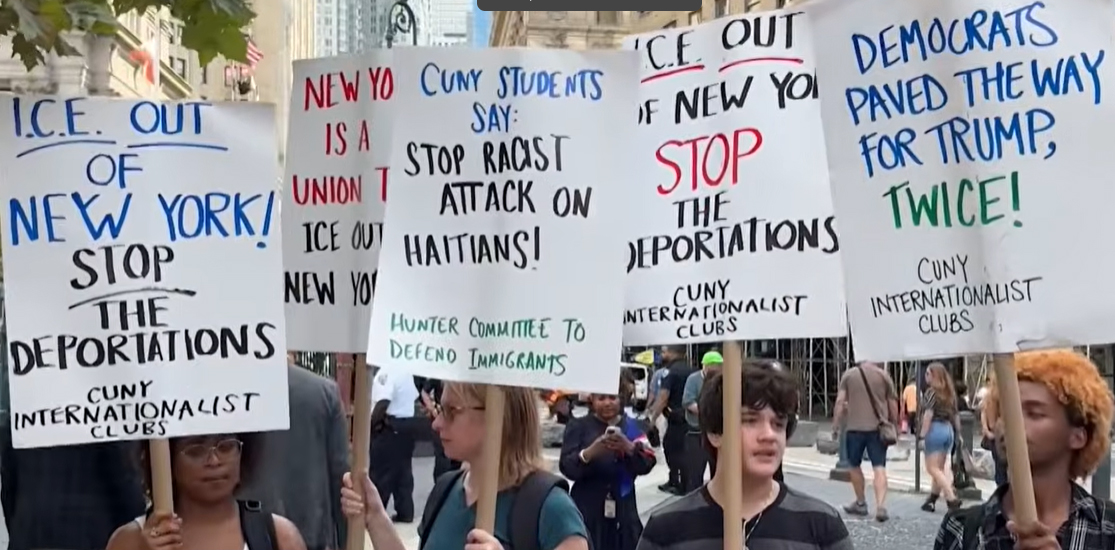
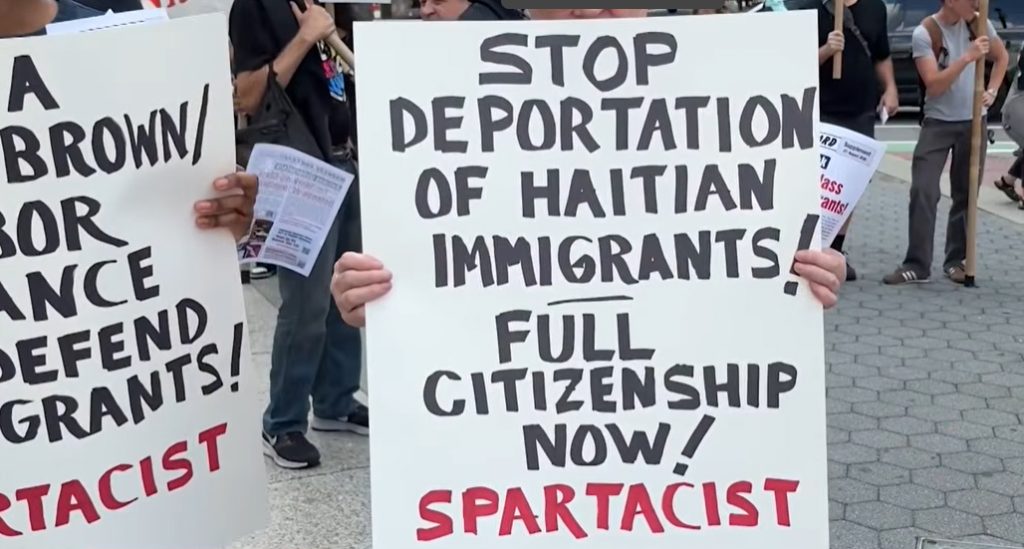
NEW YORK (Le Floridien) — Several hundred demonstrators gathered at Foley Square in Lower Manhattan on Friday, August 28, before marching through the streets of New York City to protest the termination of Temporary Protected Status for Haitian immigrants and demand stronger protections for those now facing uncertainty over their immigration status.
The demonstration brought together Haitian community organizations, immigrant-rights advocates and supporters who called on Congress to intervene following the loss of TPS protections. CBS New York reported that advocates estimate approximately 40,000 Haitians in New York have been affected by the recent Supreme Court decision that allowed the termination to move forward.
Among the organizations represented was Haitian Women for Haitian Refugees, a Brooklyn-based advocacy group. Aline Gue, the organization’s executive director, said the loss of TPS affects virtually every aspect of an immigrant’s life. Demonstrators also heard from Darnell Benoit, director of the Flatbush-based Flanbwayan Haitian Literacy Project, who delivered a straightforward message: “We are here, we’re not going anywhere, and we belong here.”
Advocates Want Congress to Act
The demonstrators are pushing beyond simply restoring temporary protection. Advocacy groups are calling on Congress to provide a pathway toward permanent residency for people who lost TPS and to pass the American Dream and Promise Act, legislation intended to provide greater legal stability to Dreamers and certain TPS holders.
The Department of Homeland Security has defended the administration’s decision, maintaining that TPS was created as a temporary humanitarian program rather than a permanent immigration status. The federal government officially terminated Haiti’s TPS on July 27, following extensive litigation over the administration’s effort to end the designation.
The consequences are particularly significant in New York, home to one of the country’s largest Haitian communities. Earlier this month, New York City Mayor Zohran Mamdani described the Haitian community as an “indispensable part of New York City,” pointing to Haitians’ contributions to health care, construction, hospitality, small businesses and the city’s cultural life.
Fear of Deportation Grows
The rally comes as former Haitian TPS holders increasingly seek advice from immigration attorneys about whether they qualify for another legal avenue, including asylum or family-based immigration petitions. CBS New York reported that attorneys are dealing with significant demand as affected immigrants search for alternatives.
The situation has become even more urgent as deportations to Haiti continue. On Friday, the United Nations reported that nearly 200,000 people have been forcibly returned to Haiti during the first eight months of 2026, already exceeding the number recorded during all of last year by at least 20,000. U.S. deportation flights resumed following the end of Haitian TPS even as Haiti continues to confront severe gang violence and a humanitarian crisis.
Friday’s demonstration illustrated that the political battle over Haitian TPS has not ended with the court decisions. For Haitian advocates in New York, attention is now increasingly turning toward Congress and the possibility of a more permanent legislative solution for immigrants who built their lives in the United States under temporary protection.