By Dessalines Ferdinand
Chief Editor, Le Floridien
MIAMI – Haiti’s 2026 FIFA World Cup journey has officially come to an end, but the story of Les Grenadiers should not be reduced to three matches, three defeats, and zero points. On paper, the results may look disappointing. In reality, Haiti’s return to football’s biggest stage after more than five decades carried a meaning far greater than the scoreboard.
For many Haitians, especially those in the diaspora, this World Cup was not only about winning games. It was about seeing the Haitian flag again among the greatest football nations in the world. It was about pride, unity, emotion, and the reminder that even in difficult times, Haiti can still produce moments of joy.
Against stronger and more experienced opponents, Haiti showed courage, discipline, and fighting spirit. The players did not always have the quality or depth to compete for 90 minutes at the highest level, but they never stopped trying. They represented a country that needed something positive to hold on to.
One of the unforgettable moments of Haiti’s campaign came from Wilson Isidor. His spectacular long-distance goal against Morocco is already being mentioned among the top five long-range goals of the tournament so far. It was a moment of beauty, confidence, and individual quality; the kind of goal that reminds the football world that Haitian players can produce magic on the biggest stage.
More Than Three Matches: A Journey That Reunited a Nation
That goal mattered beyond the scoreline. It gave Haitian fans something to celebrate, something to replay, and something to remember. In a tournament where Haiti had to fight for respect, Isidor’s strike became a symbol of pride. It showed that even when the results were not going Haiti’s way, the team still had players capable of creating world-class moments.
Perhaps one of the most remarkable signs of this World Cup was the way the Haitian people embraced their own team. In past tournaments, many streets, homes, businesses, cars, and motorcycles in Haiti were usually decorated with the colors of Brazil, Argentina, France, Germany, or other favorite international teams. Those flags often represented admiration for football giants that Haitians followed with passion for generations.
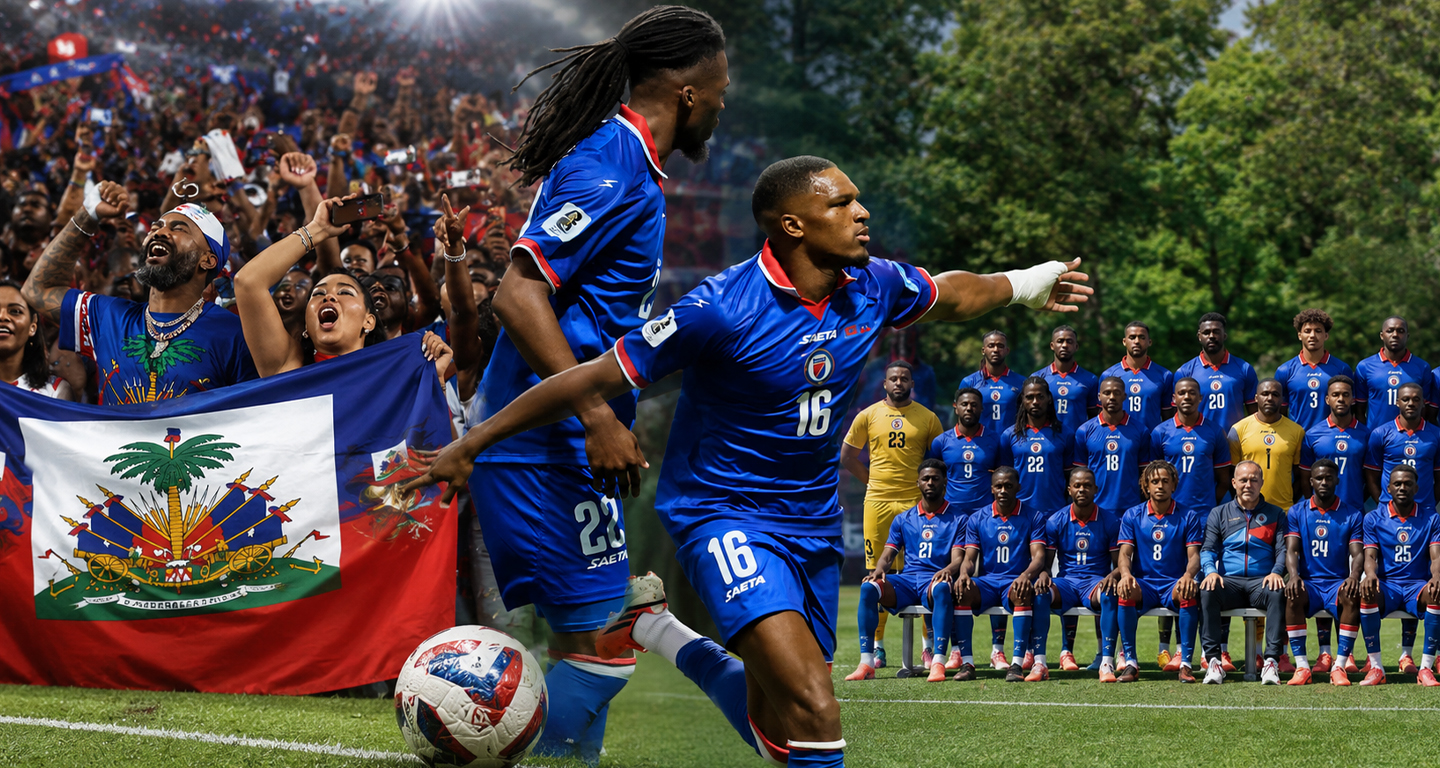
But this year was different. Those traditional colors were, in many places, replaced by a sea of red and blue. Across Haiti, the national colors became the dominant symbol of support. The Haitian flag appeared everywhere — in neighborhoods, on social media, at viewing parties, in homes, and in the hands of fans who finally had their own team to cheer for on the world stage. For once, Haitians did not have to borrow another nation’s football dream. They had their own.
That shift says a lot about the emotional power of this World Cup. It was not simply about Haiti playing three matches. It was about national identity. It was about people choosing to stand behind their own flag, despite the difficult reality of the country. For a few weeks, Les Grenadiers gave Haitians a rare reason to feel united, proud, and visible in front of the world.
The images of Haitian supporters in the stadiums, wearing red and blue, waving flags, singing, and celebrating their identity, may remain among the most powerful memories of this campaign. From Boston to Philadelphia and Atlanta, Haitians showed the world that their national team is more than a football team. It is a symbol of hope.
This World Cup also reminded the Haitian diaspora of its deep connection to the homeland. In South Florida, New York, Boston, Philadelphia, Atlanta, Montreal, Paris, and everywhere Haitians live, the team became a reason for families and communities to gather. For a few weeks, football created unity across borders.
Now the most important question is: what comes next?
From World Cup Heartbreak to Renewed Hope for Haitian Football
The 2026 World Cup should not be treated as the end of a dream, but as the beginning of a new cycle. The Haitian Football Federation must build on this experience, invest in youth development, strengthen the national team structure, and make sure this generation of players becomes the foundation for the future.
There are lessons to learn. Haiti needs better preparation, more competitive friendly matches, stronger organization, and a long-term development plan. The country must also continue identifying talented players from the diaspora while giving more opportunities to young players developed in Haiti.
The road to the next World Cup will not be easy, but this campaign proved that Haiti belongs in the conversation. The team may not yet be among the elite nations, but it has heart, talent, and potential. With better planning and continued investment, Les Grenadiers can return stronger.
Haiti may have left the tournament without a victory, but it did not leave without respect. The scoreboard says the journey is over. But for Haitian football, this may only be the beginning.
The World Cup is over for Haiti, but hope begins now.