As Haiti prepares for its historic return to the FIFA World Cup after a 52-year absence, expectations from the international soccer community remain extremely modest. In fact, many analysts and experts who have attempted to rank the 48 participating nations place Haiti near the bottom of the list when it comes to predicting which teams are capable of making a deep run in the tournament.
For many observers, Haiti’s placement in a group featuring Brazil, Morocco, and Scotland is enough to dismiss the Grenadiers before a ball has even been kicked. Brazil enters the tournament as one of the traditional giants of world football. Morocco stunned the world by reaching the semifinals of the 2022 World Cup and has continued to establish itself among the elite nations. Scotland, meanwhile, arrives with players competing in some of Europe’s strongest leagues and carries years of experience against top-level opposition.
On paper, Haiti appears to be the clear underdog. Yet World Cups are not won on paper.
One of the reasons the tournament captures the imagination of billions of fans is that every edition produces surprises. The history of the World Cup is filled with teams that were expected to fail but managed to shock the football world. Whether it was Cameroon in 1990, Senegal in 2002, Costa Rica in 2014, or Morocco in 2022, underdogs have repeatedly reminded everyone that predictions are not guarantees.
Haiti understands better than most what it means to defy expectations.
The very fact that the Grenadiers qualified for the 2026 World Cup represents a remarkable achievement. The team had to overcome challenges that few other national teams have faced. Political instability in Haiti, the inability to host international matches at home, logistical difficulties, and limited resources compared to many competitors could have easily derailed the program. Instead, the players and coaching staff remained focused on their objective and secured a place on football’s biggest stage.
What makes Haiti dangerous is that the team enters the tournament with virtually no pressure. While Brazil, Morocco, and Scotland will be expected to deliver results, Haiti can play with freedom. The Grenadiers feature several players competing professionally in Europe and North America, including forward Wilson Isidor of Sunderland in the English Premier League, midfielder Jean-Ricner Bellegarde of Wolverhampton Wanderers, also in the Premier League, Frantzdy Pierrot with AEK Athens, and forward Louicius Don Deedson, who plays for OFK Beograd in Serbia’s top championship. The squad has also demonstrated growing organization, discipline, and confidence under head coach Sébastien Migné.
The team’s performances in the weeks leading up to the World Cup have also provided reasons for optimism. Although friendly matches cannot be compared directly to World Cup competition, they have offered valuable insight into Haiti’s progress and ability to compete against a variety of international opponents.
A closer look at those results paints a more encouraging picture than many people realize. Haiti suffered a narrow 1-0 defeat to Tunisia and followed that with a hard-fought 1-1 draw against Iceland. The Icelandic side later faced Argentina and lost 3-0, highlighting the level of competition Haiti encountered. The Grenadiers then delivered one of their most convincing performances in recent years with a commanding 4-0 victory over New Zealand. That result gained additional significance when New Zealand later held its own against England before losing by only a 1-0 scoreline.
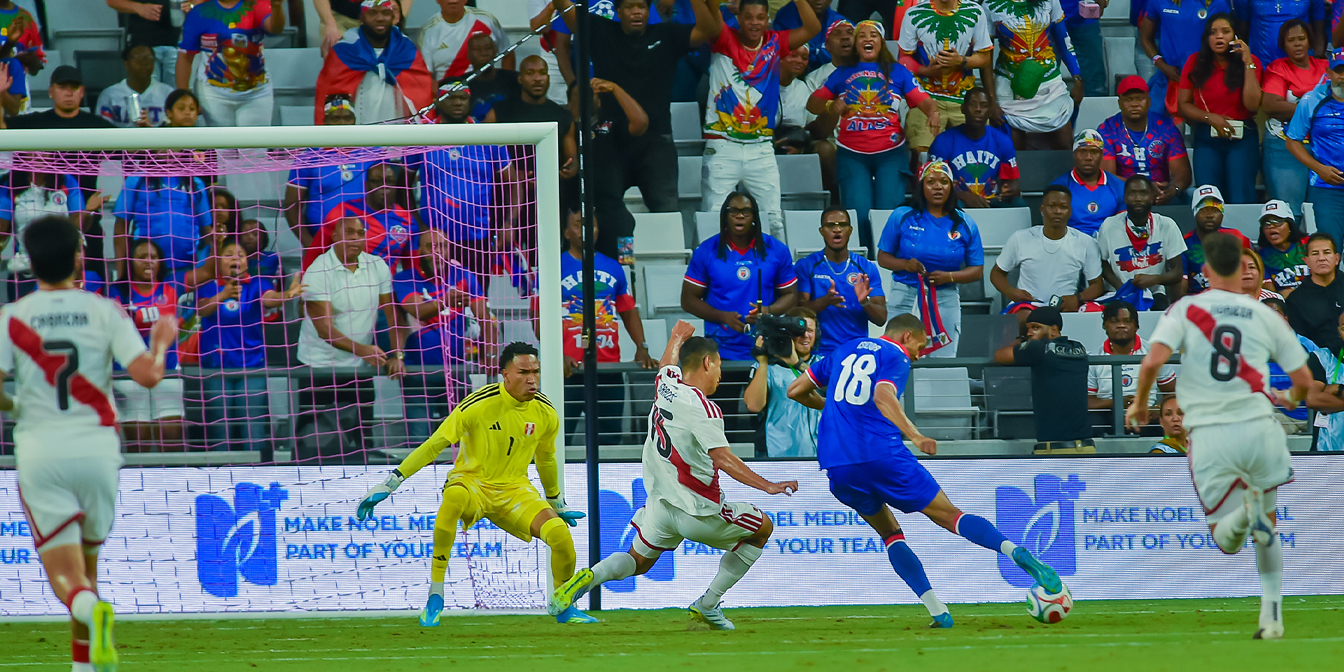
Perhaps the most encouraging performance came in Haiti’s 2-1 loss to Peru. Despite facing a South American team ranked significantly higher in the FIFA standings, Haiti took the lead and largely controlled the match through the first 60 minutes. The Grenadiers matched Peru’s intensity, organization, and technical quality for long stretches before late mistakes allowed the Peruvians to rally for the victory. While the final result was a defeat, the performance demonstrated that Haiti can compete with established football nations when playing at its best.
Of course, realism is necessary. Advancing from a group that includes Brazil, Morocco, and Scotland would be a tremendous challenge. Most experts would still consider Haiti the least likely team in the group to reach the knockout stage.
But perhaps that is exactly where Haiti wants to be.
When a team is ranked near the bottom of all 48 participants, every positive result becomes an opportunity to change the narrative. A draw against one of the favorites, an upset victory, or even a highly competitive performance could become one of the stories of the tournament.
For Haitian fans, the objective is not only about advancing to the next round. It is also about representing the nation with pride, showing the world the talent and resilience of Haitian football, and inspiring a new generation of players both in Haiti and throughout the diaspora.
The experts may place Haiti near the bottom of their rankings. The betting markets may predict an early exit. The statistics may favor every opponent.
But World Cups have a way of creating unforgettable stories.
And Haiti arrives in 2026 with nothing to lose—and perhaps everything to gain.