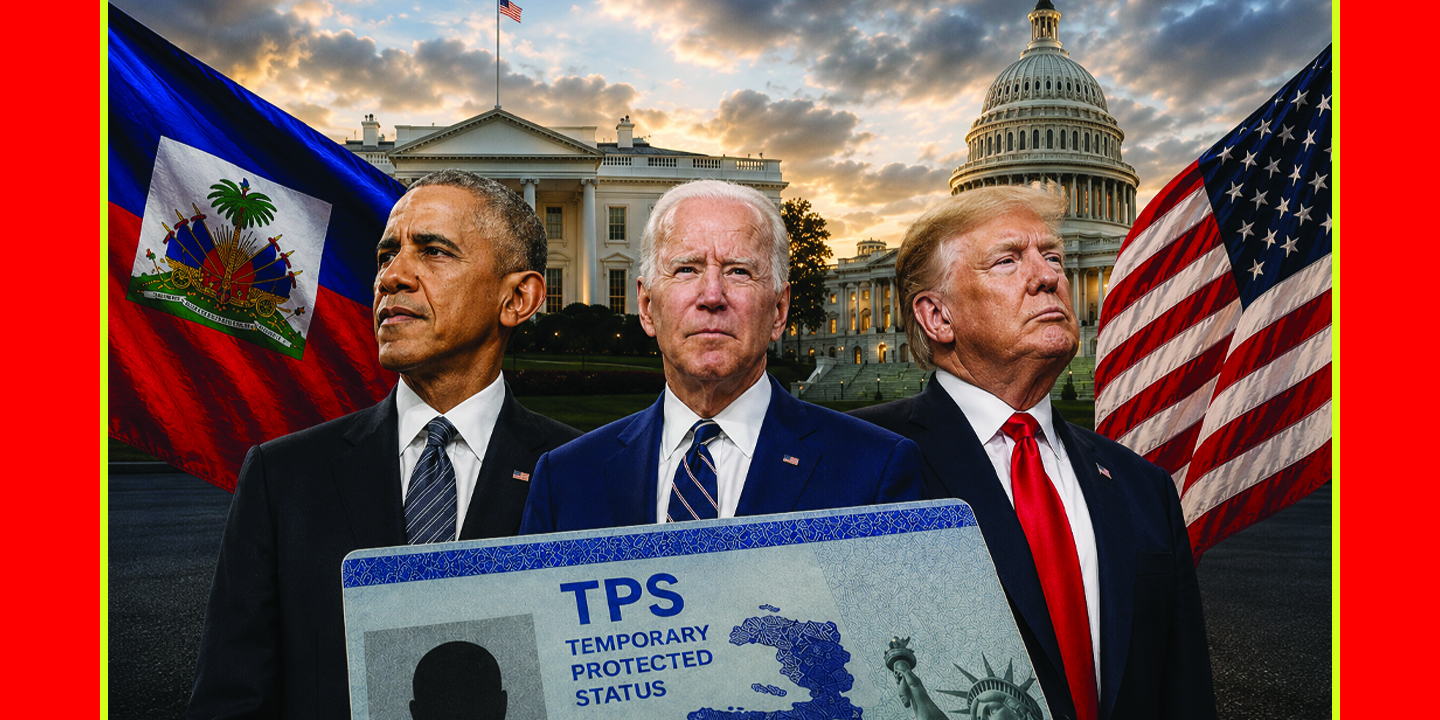
For more than 15 years, Haitian TPS evolved from an emergency humanitarian protection into a long-term reality for thousands of families who built careers, businesses and deep roots in the United States. This first installment of a Le Floridien opinion series examines how Washington allowed “temporary” status to endure for so long—and why both political parties must share responsibility for failing to provide a lasting solution.
When the United States granted Temporary Protected Status to Haitians following the catastrophic earthquake of January 12, 2010, few could have imagined that more than a decade and a half later, TPS would remain one of the most consequential—and controversial—issues confronting the Haitian-American community.
The original decision made sense.
Haiti had just suffered one of the worst natural disasters in its history. Hundreds of thousands of people were killed or injured, neighborhoods were destroyed, government institutions were severely damaged, and an already fragile country faced an enormous humanitarian emergency.
Returning Haitians to those conditions would have been difficult to justify.
The Department of Homeland Security, under President Barack Obama’s administration, designated Haiti for TPS effective January 21, 2010, allowing eligible Haitians already in the United States to remain temporarily and obtain authorization to work.
The key word was temporarily.
Yet what followed illustrates one of the fundamental problems with America’s immigration system.
Temporary protection continued. Conditions in Haiti repeatedly prevented an easy resolution. Administrations changed. Presidents changed. Policies changed. Court battles followed.
But while Washington debated whether TPS should continue, Haitian beneficiaries were doing something much more ordinary:
They were living.
They worked. They paid taxes. They raised children. They rented apartments and bought homes. Some started businesses. Others became nurses, nursing assistants, construction workers, drivers, hotel employees, restaurant workers, managers and professionals.
Children who were young when their parents received TPS grew into adults.
American-born children entered elementary school, graduated from high school and, in some cases, went to college.
A temporary immigration designation gradually became attached to increasingly permanent human lives.
That is the contradiction America must now confront.
The Problem Did Not Begin With Trump
As the Trump administration moves forward with ending Haiti’s TPS designation, it is understandable that much of the anger within the Haitian community is directed at President Donald Trump and his immigration policies.
But if we want to understand how we reached this point, the story cannot begin with the current administration.
The problem is much older.
It crosses political parties and presidential administrations.
Democratic and Republican governments both had opportunities to confront the long-term future of Haitians living under TPS. Congress had even more time.
Yet Washington repeatedly postponed the most difficult question:
If people are legally permitted to remain in the United States year after year, at what point does the government need to address the permanent reality that has developed around that temporary status?
TPS was never designed to be a direct pathway to permanent residency.
That fact should not be ignored simply because we disagree with the current termination.
The Trump administration and supporters of termination have a legitimate point when they argue that “temporary” cannot automatically mean “permanent.”
If every TPS designation eventually became permanent residence simply because enough time had passed, the program would effectively become something different from what Congress created.
That is a serious policy concern.
But there is another side to the argument.
Government cannot repeatedly authorize people to remain and work, watch them establish roots for many years, and then pretend those years produced no consequences.
This is where Washington failed.
Instead of creating a long-term mechanism to address people who remained under TPS for extraordinary periods, the political system relied on extensions, redesignations, administrative decisions and litigation.
Each extension postponed the political problem.
It did not solve it.
And with every additional year, the consequences of an eventual termination became more complicated.
A person who receives temporary protection for 18 months is one thing.
A person who has legally worked, raised children and established a household in America over many years presents a fundamentally different public-policy challenge.
The immigration designation may still say “temporary.”
The person’s life no longer is.
Washington Called Their Status Temporary—Their Lives Became Permanent
This distinction is essential because discussions about immigration too often reduce human beings to categories.
Legal. Illegal. TPS. Asylum. Parole. Deportable.
Those classifications matter under immigration law.
But they do not fully describe what happens over many years.
Consider a Haitian TPS holder who has spent more than a decade working legally in the United States.
During those years, that person may have paid hundreds of rent or mortgage payments. An employer may have invested years training that worker. A business owner may have built a company. A nursing assistant may have cared for hundreds of American patients. A parent may have raised children who are U.S. citizens.
None of these things automatically gives someone a legal right to permanent residence.
But neither should they be irrelevant when government designs immigration policy.
That is precisely why the Haitian TPS situation is so difficult.
The United States did not give these individuals permanent status.
But neither did it require them to live as though they might leave next Tuesday.
They were authorized to work. They were permitted to build lives.
And human beings naturally responded to years of stability by doing what people everywhere do: they established roots.
South Florida provides a particularly visible example.
Haitians have become deeply woven into the economic and cultural life of Miami-Dade, Broward and surrounding communities.
They own businesses, work in healthcare, transportation, hospitality and construction, purchase property, attend churches, raise families and contribute to local economies.
Similar stories can be found in Boston, New York, New Jersey, Ohio and other communities with substantial Haitian populations.
This is why the end of TPS cannot realistically be viewed as merely the expiration of an immigration document.
It touches an entire network surrounding each beneficiary: employers, children, spouses, customers, patients, tenants, lenders, schools, churches and businesses.
The longer a temporary population is allowed to establish itself, the more complicated removing that population eventually becomes.
Washington had years to recognize this.
Instead, it waited.
There is also an important distinction between acknowledging those roots and arguing that TPS itself should automatically become permanent.
They are not the same thing.
The government has a legitimate interest in preserving the temporary character of a temporary immigration program. But Congress also has the power to recognize exceptional circumstances created when temporary protection continues for an extraordinary length of time.
That is where the political system failed Haitian TPS holders.
Washington kept extending temporary protection without resolving what would happen to those who had spent years building their lives under it.
Fifteen Years Later, Washington Must Answer the Question It Postponed
There is a temptation within our community to frame the TPS debate in the simplest possible terms.
One side says Haiti remains dangerous and therefore TPS must continue.
The other says TPS is temporary and therefore it must eventually end.
Both arguments contain elements of truth.
But neither, by itself, answers the larger question.
The real failure was allowing the issue to remain unresolved for so long.
If Washington believed Haitian TPS should eventually end, policymakers should have developed a realistic transition years ago.
If lawmakers believed long-term beneficiaries deserved an opportunity to remain permanently, Congress should have debated and voted on legislation providing such a pathway.
Instead, America largely chose a third option:
Wait.
Extend.
Wait again.
Litigate.
Extend again.
Change administrations.
Fight in court.
And leave hundreds of thousands of people uncertain about their ultimate future.
That approach was politically easier than solving the problem.
But political postponement has a price.
We are paying that price today.
The Trump administration can argue that TPS was never intended to last indefinitely.
Its critics can argue that conditions in Haiti remain extraordinarily dangerous and that terminating protection now is both impractical and inhumane.
Those arguments will continue.
But there should be one point on which both sides can agree:
An immigration system that leaves hundreds of thousands of people in temporary status for more than a decade without establishing a credible long-term resolution is not functioning properly.
The Haitian community should also learn from this experience.
For years, much of our advocacy understandably concentrated on obtaining the next TPS extension.
Extend it another six months.
Another year.
Another 18 months.
Each extension provided necessary relief.
But every extension also moved the same unresolved question further into the future.
Eventually, the future arrived.
That moment is now.
The debate therefore needs to become larger than whether the Trump administration should have terminated Haitian TPS.
America must ask what responsibility government assumes when temporary protection lasts long enough for people to establish substantial economic, family and community ties.
And Haitian-American leaders must ask whether continuing to fight primarily for the next temporary extension is enough.
Those are uncomfortable questions.
But after more than a decade, avoiding them is precisely what brought us here.
Washington may have called their status temporary.
Their lives did not remain temporary.
And no serious discussion about what happens next can ignore that reality.
Coming in Part II: After TPS: Can America Really Remove 350,000 Haitians—and Can Haiti Receive Them? The next installment will examine the economic and logistical realities of TPS termination on both sides—from American employers, families and communities to Haiti’s capacity to absorb a potentially significant number of returnees.